
Strictly speaking, “autostereoscopy” (3D) is a technology that allows users to view realistic three-dimensional images with the naked eye. It dones not the need for special equipment such as helmets or 3D glasses. It works by projecting pixels corresponding to the left and right eyes. Respectively, using the principle of parallax to produce a three-dimensional image. The 3D movies theaters are examples of this principle.
However, concepts like “autostereoscopic 3D large screens” and “autostereoscopic 3D immersive caves” that we often encounter are not strictly “autostereoscopic 3D” but rather “anamorphosis” or anamorphic illusions.
Anamorphosis is an art form that uses the principles of perspective to create visual illusions. It transforms a flat image through specific perspective transformations, transforming it into an image that only appears true when viewed from a specific angle. This technique is widely used in painting, photography, architectural design, and visual effects.
Anamorphosis has been used in painting as early as the 16th century. Hans Holbein the Younger is renowned for his masterful use of anamorphosis, with “The Ambassadors” being one of his masterpieces.
From the front, the painting appears to have a severely distorted skull at the bottom, but from another angle, it appears as a three-dimensional skull.
Although both “autostereoscopy” and “anamorphosis” utilize visual principles to create optical illusions. However, their implementation methods and applications differ, making them distinct concepts.
Now that we understand what “autostereoscopy” is, let’s take a look at the CAVE system.
CAVE, short for Cave Automatic Virtual Environment, was first invented in 1992 by Carolina Cruz-Neira, Daniel J. Sandin, and Thomas A. DeFanti of the Electronic Visualization Laboratory at the University of Illinois at Chicago. It’s a virtual reality system based on a projector or LED screen:
Anamorphosis videos are currently popular within CAVE systems. Typically, there’s a “sweet spot” within the CAVE space. This spot can be either inside or outside the space, allowing viewers to experience the “out-of-screen” effect brought about by anamorphosis, resulting in a unique visual experience. Simply put. The immersive CAVE room system is a fully immersive virtual reality display system and human-computer tracking interaction system.
It is a CAVE visual collaborative environment based on multi-channel visual synchronization technology, three-dimensional space shaping correction algorithm, and stereoscopic display technology. The system provides a room-sized four-sided (or six-sided) cube projection or LED display space for multiple people to participate in the interaction.
All participants are fully immersed in a virtual simulation environment surrounded by a three-dimensional scene. With the help of corresponding virtual reality interaction equipment ,such as data gloves, force feedback devices, position trackers, etc.) participants can get a fully immersive three-dimensional interactive experience.
A Cave Immersive Room can transform physical spaces into walk-in 3D worlds. By projecting high-resolution stereoscopic images onto multiple surfaces, it creates an interactive, collaborative, and lifelike experience without the isolation of a headset.
Multi-surface display on walls, floor, and ceiling. It creates a 270°–360° walk-in virtual environment.
Supports multiple users wearing 3D glasses and interactive devices for entertainment.
Advanced tracking system adjusts visuals instantly to user movements as like natural immersion.
Crystal-clear stereoscopic images for realistic models, simulations, and complex data.
Flexible custom design space size and application needs such as education, research, design, or training..
Compatible with various VR software and data platforms

High-resolution LED panels replace traditional projectors. It has more brighter images, seamless splicing, and true 3D stereoscopic visualization across walls, floor, and ceiling.
Powerful computing servers handle real-time rendering, perspective projection matrix calculations, and multi-channel image generation for smooth immersive visuals.
Integrates video processors, image splitters, and synchronization controllers to manage data distribution and seamless LED display performance.
Immersive surround sound ,such as 7.1.4. It can enhance the VR environment with realistic audio cues for training, simulation, and entertainment.
Motion tracking, sensors, and gesture-based controllers. They allow users to interact naturally with 3D models and navigate the virtual environment.
Virtual simulation software manages image segmentation, real-time synchronization, and content integration. It supports multimedia formats including text, images, voice, and video.


A 5-sided immersive LED display is a fully engaging environment for audiences. Unlike traditional flat screens, It consists of five LED screens on the front, left and right sides, top and bottom. The structure surrounds viewers with high-resolution, high-brightness content, making them feel as though they are “inside” the video. Therefore, they are often used in virtual production studios, simulation training, museums, corporate showrooms, retail experiences, and entertainment venues.

A 4 sided immersive LED display is typically built with three vertical LED walls and an LED floor. Viewers stand inside the structure and experience visuals coming from the front, both sides, and beneath their feet. So it creates the sensation of being fully surrounded by digital content. With high-resolution, seamless visuals and synchronized content playback, a 4-sided immersive LED display screen transforms storytelling and brand presentations into engaging, lifelike experiences.


When you are selecting a curved LED display, you need consider several technical factors.
You should Choose a high-resolution LED dome or curved screen for viewing distance; We recommend smaller pixel pitch , like P1.2–P2.5 to ensure sharper visuals for immersive experiences.
The system supports glasses-free 3D. It allows all viewers to experience depth perception without headsets, enhancing immersion.
Evaluate the quality and range of motion seats or suspended platforms, including tilt, lift, and rotation speed;
The LED display has sufficient brightness more than ≥600 nits and high refresh rate ≥3840Hz to prevent flicker and maintain smooth visuals
You should Consider support for wind, water spray, smoke, and scent effects. It can enhance multi-sensory immersion and overall realism.
The system should offer user-friendly software for operation, content scheduling, and maintenanc. It can make staff to manage films, effects, and motion sequences efficiently.
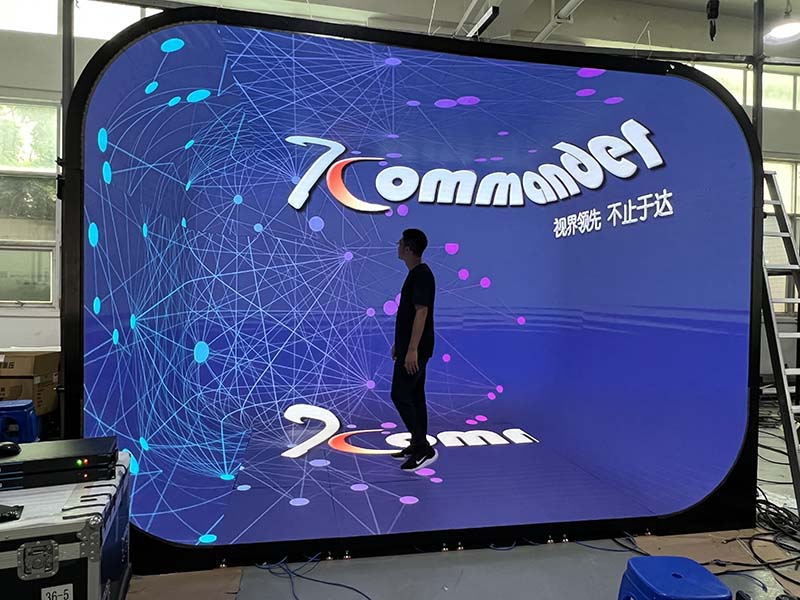

In today’s market, For the entry-level small projection-based four-panel CAVE , such as 3 walls + floor, approximately 3 x 3 x 2.7 m , the cost is typically US$150,000–300,000. For a project-level setup, the cost is approximately US$300,000–600,000. If you are expanding to 5 or 6 panels and using LED displays, it can cost upwards of US$500,000–750,000.
Cost Structure and Technical Key Points
Display System
Projection Type:
Each panel typically uses 1 to 4 projectors, depending on the target resolution,brightness and redundancy. These are paired with short-throw, ultra-short-throw lenses. You need Geometric correction and soft convergence by specialized software and automatic camera calibration.
LED Type:
In general, it uses P1.2 to P1.8 fine pitch LED display with load-bearing floor tiles.
Prons:
Cons:
Rendering and Synchronization
Using Multiple graphics workstations (IGs) and synchronization,frame lock, it can ensure 90/120 Hz stereo or high-smooth viewing. Entry-level requirements include 1 to 2 high-end GPUs; higher resolutions,polygon counts require clusters of 3–6.
Interactive Tracking
Optical (active/passive) or hybrid 6DoF head/hand tracking, synchronized with stereo glasses ,such as active shutter or polarization. Accuracy and occlusion requirements require high space and layout requirements.
Screen/Structure and Construction
They often account for 15–30% of the hardware installation or integration cost.
Radiant
Dimensions and Pixel Selection
Common spaces:
3×3×2.7 m (three walls + floor) or 4×4×3 m (four walls + floor).
This size accommodates 2 to 6 people collaborating and facilitates projection or LED installation and maintenance.
Viewing distance and pixels:
Rule of thumb – minimum comfortable viewing distance d_min (meters)
≈ pixel pitch p (mm) × 1.0–1.5.
If the viewer is 1.5–2.0 meters from the wall, We recommended p ≤ 1.5 mm (LED) or an equivalent pixel density ≥ 2–3 MP/screen (effective pixels after projection blending)
Projection resolution planning:
For a 3×3×2.7 m projection area, a single screen with an effective ≥ 4K width will provide significantly better viewing experience. You can achieve UHD width with 2×WUXGA/4K blending; for detail and stereo redundancy, you can use 3 to 4 screens.
Brightness planning:
For darkroom stereo viewing, we recommend 80~120 cd/m² on the wall. Lumen redundancy is determined by rear-projection,hard screen gain selection. LEDs can easily meet 300–600 cd/m² and adjust downwards.
Projection vs. LED CAVE System Pricing
Projection CAVE (3 walls + floor, 3 × 3 × 2.7 m)
Hardware Example:
Includes
Budget:
Entry-level (2×WUXGA/side, basic tracking): US$150k±;
Engineering-level (4×WUXGA/side or 2×4K/side, advanced tracking): US$300–600k;
Historical price difference between dihedral and fully configured hexahedral projectors: approximately €80k to €750k.
Area estimate: Three walls (3 × 2.7 × 3) = 24.3 m²; floor (9 m²); total ≈ 33.3 m².
Panel cost (2025 industry reference):
The P1.2 to P1.8 small pitch LED display price is approximately US$1,200–4,500/m². Of course, LED display prices vary significantly depending on brand, package, refresh rate, and grayscale. Furthermore, installation and system integration typically account for 15–30% of the total cost.
Rough estimate:
The screen alone costs approximately US$40k to 150k. Adding the controller or processor, load-bearing floor tiles, structure, synchronization ,tracking, and installation, the CAVE LED display complete system typically costs US$150k to 350k. If you choose a top-tier brand, suh as 120 Hz+, HDR/high-protection, and custom structure, the price rises to US$400k–600k.
Configuration Recommendations (Based on Goals and Budget)
If you prioritize realistic simulation and low maintenance, we recommend a P1.2 to P1.5 LED display at 3840 Hz and ≥16-bit grayscale. Also, you need to consider the floor tile screen’s load-bearing capacity and anti-glare treatment.
If you prioritize cost-effectiveness and flexible expansion, we recommended a projection configuration.
You can use 2–4 screens per panel, equipped with Scalable or VIOSO automatic calibration, with lens and refresh rate margins.
Other Costs
Consumables/Maintenance: Bulbs/light sources, filters, alignment recalibration, camera calibration, and software license renewal; monthly operating and maintenance costs for large-scale CAVEs.
Note:
The above prices are industry prices for 2025 and are estimates based on experience. Actual quotes may vary due to differences in brand, COB/MiP, structural requirements, and delivery location. If you can provide approximate room dimensions, target resolution, refresh rate, whether stereoscopic is used, and whether a mix of headsets is used, we can provide a more accurate price estimate.
Although almost any video can be adapted to create a “glasses-free 3D” effect in a CAVE environment, achieving a stronger sense of immersion requires certain features: The visuals should have depth, spatial perception, and layering. Camera movements such as forward tracking or rotation enhance the effect. Objects in the scene should move from far to near, or from inside to outside, creating a “pop-out” effect. For aerial footage, applying speed-up effects often produces better results.
Table of Contents
Toggle
SightLED is a professional LED display manufacturer, providing high-quality and customizable indoor and outdoor LED displays for advertising, events, sports, and more. With over 15 years of experience and certifications such as ISO9001-2015, CE, and TUV, we ensure reliable post-sale services and customer satisfaction. Trust us to meet your specific needs and provide long-term quality services.
Feel free to visit our factory
Welcome to SightLED Support!
Need help or have questions about our LED display solutions? We're here to assist you. Start a chat now!
Start Chat