
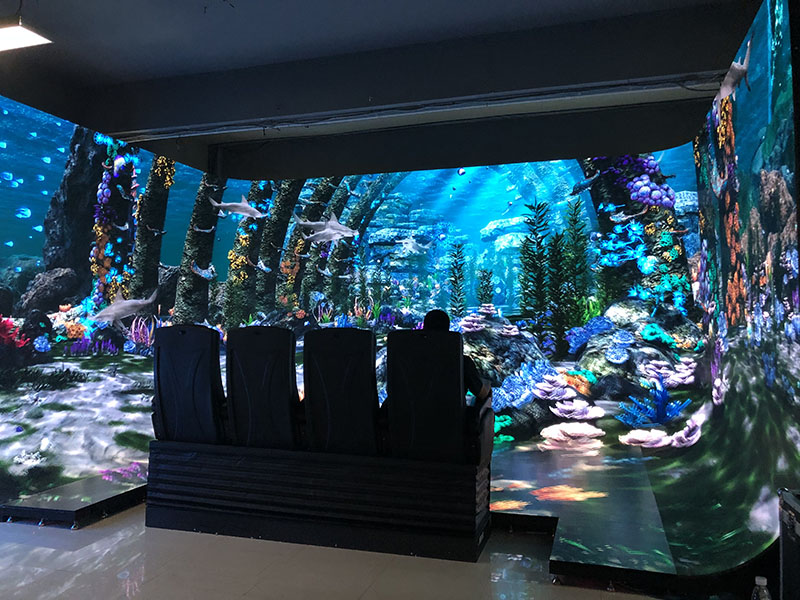

Three-sided immersive LED screen is the basic configuration for building an immersive visual space, usually composed of the following combination: Double wall + ground screen: Using two LED wall screen and a ground LED screen together to create a three-dimensional visual experience. Three wall screen: three sides are LED wall screen, forming an omni-directional package of visual effects. This configuration requires each piece of LED screen with similar specifications parameters to ensure visual coherence and unity, for the audience to bring the illusion of being in a real scene.

Compared with the three-side screen, the four-side immersive LED panel screen further enhances the audience’s sense of immersion and interactive experience by adding a display area (ceiling or floor). Three wall screen + ceiling screen Three wall screens + floor screen Tunnel Layout: Combining two wall screens, ceiling screen and floor screen to form a closed visual space, blurring the boundaries between virtual and reality. With the realistic sound effects, the whole environment is more lifelike.

The five-sided immersive LED screen is the pinnacle of immersive display technology, which creates a closed and highly immersive visual environment through the all-around combination of three wall screens (or vertical screens), ceiling screens and floor screens. This configuration not only provides the ultimate immersive experience, but also makes the audience seem to be wrapped in a cocoon composed of LED video screen, isolated from the outside world.
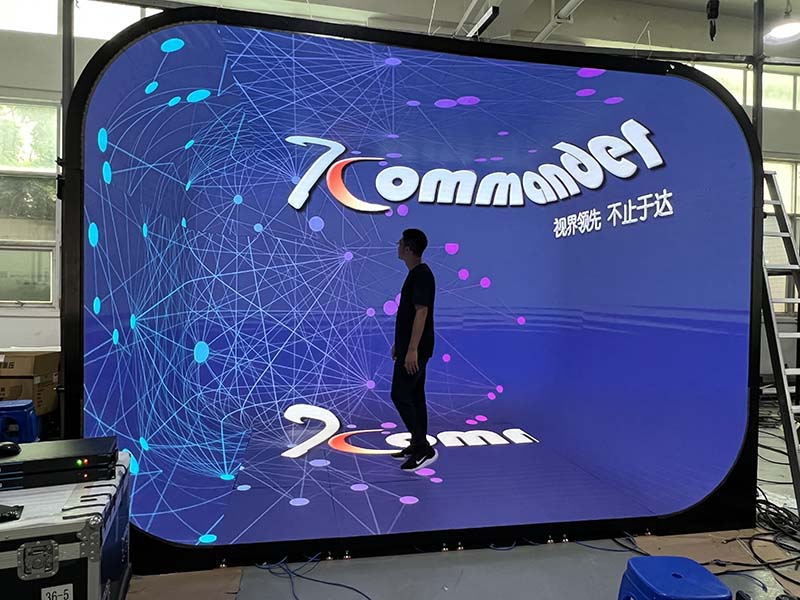


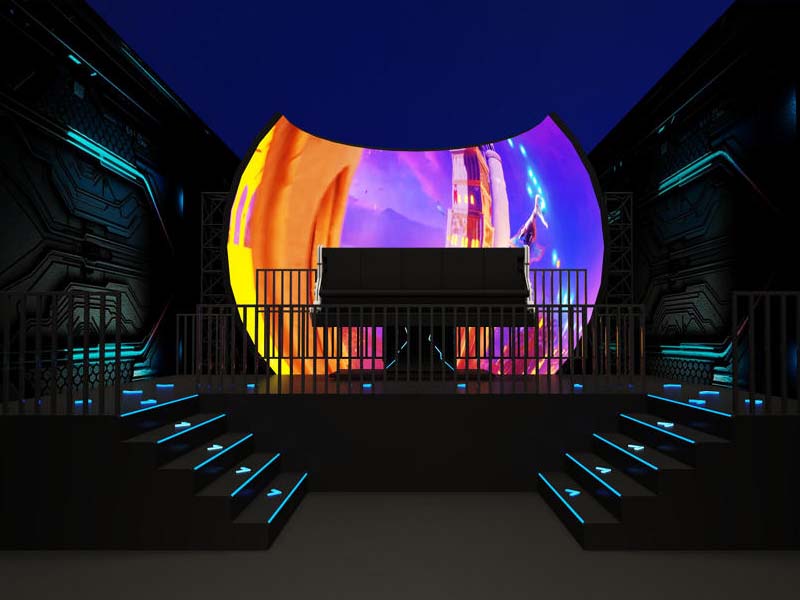

Field Dimensions: 4.5m (Height) x 6.5m (Width) x 8m (Depth)
Ball Diameter: 5.2m
Number of Seats: 8–10

Field Dimensions: 13m (Height) x 12m (Width) x 12.5m (Depth)
Ball Diameter: 10m
Number of Seats: 20


A tilted dome is suitable for both planetariums and entertainment venues.
For planetariums, the entire dome surface is visible. It can provide a complete viewing experience.
For entertainment settings, it offers stronger visual effects and immersive experiences, making audiences feel as if they are truly inside the scene.
Fixed dome theaters:
The seating can be arranged in tiers so that every audience member has an unobstructed view.
Portable dome theaters:
The layout can combine cushions or beanbags in the front, chairs in the middle, and standing areas at the back.
However, since the front of the screen is close to the ground, visitors entering or exiting during screenings may cast shadows onto the screen.
On the positive side, the outer dome surface can also be customized with stickers or graphics to better match the event theme.
Advantages / Disadvantages
Applications

The inflatable dome theater is considered an entry-level dome cinema.
Its entire structure is supported by air pressure, allowing for quick setup and easy transport. The projection system typically uses an integrated single-server with a fisheye lens, saving space, enabling mobility, and still ensuring good image quality.
This dome uses a single-layer inflatable design. Therefore, it is very lightweight and ideal for mobile events. Moreover, assembly is simple. It can usually be completed within 30–60 minutes.
However, because the material is not waterproof and the fabric is lightweight, it is not suitable for outdoor use in windy or rainy conditions. It is best for indoor setups or requires a protective canopy if used outdoors.
The interior projection is displayed on a horizontal plane, allowing audiences to lie down and gaze at the stars and ocean, with beanbags or floor mats enhancing the immersive experience.
Advantages / Disadvantages
Applications

The open dome requires relatively little space. It does not need crowd-control measures, allowing audiences to come and go freely.
Depending on the installation method, it can take two main forms: ceiling-mounted domes and frame-supported domes.
Ceiling-mounted domes rely on the building’s ceiling structure to support the weight of the dome.
Frame-supported domes use an independent support system, giving the entire structure a pavilion-like appearance.
With ceiling-mounted domes, the hanging screen fabric can be lowered or retracted depending on ambient light. It can bring flexible adjustment of the viewing experience. Even when not in use, the dome does not occupy valuable floor space.
For venues with limited space, the open dome is an excellent choice.
Advantages / Disadvantages
Applications

As the core setup of "flying theaters" in theme parks and tourist attractions, the vertical dome has become increasingly popular.
The dome screen is shaped like a hemisphere. By fully surrounding the audience, it can bring a boundless, near-real visual experience.
Combined with suspended flying-simulator seats that synchronize with the film’s camera movements, the dome creates a highly immersive viewing effect.
When paired with motion-based suspended seats, the vertical dome theater can simulate the movements seen in the film. As viewers watch, their seats tilt, sway, or rotate in sync with the content, producing a convincing sensation of flight and motion.
To ensure safety and stability, additional engineering is needed to support and distribute the vertical dome’s structural load.
Advantages / Disadvantages
Applications
In today’s ever-changing technology,immersive experiences have become a hotspot. They have not only redefined many fields such as entertainment, education and exhibition, but also greatly enriched people’s daily life experience. In this wave, immersive LED display is indeed the core component. So, what is immersive LED display screen? How much does Immersive 3D LED screen cost?
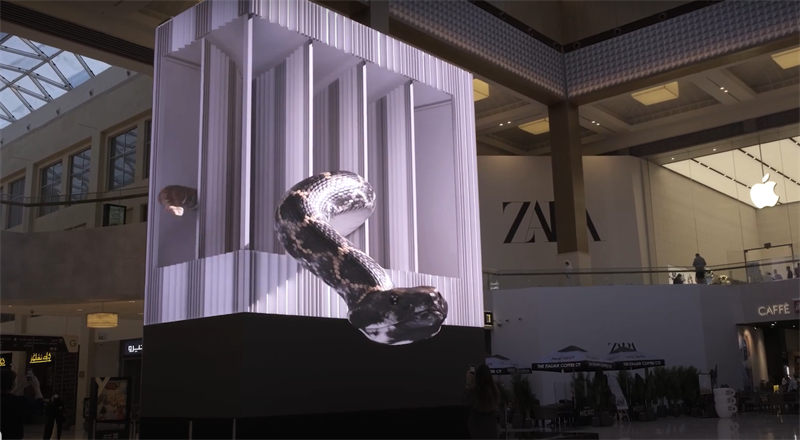
AR and VR are the two pillars of creating an immersive experience.
Augmented reality is a technology that superimposes virtual information on top of real-world scenes. It utilizes computer-generated images, videos, sounds and other multimedia information, which is presented to the user through specific display devices (such as smartphones, tablets or AR glasses), enabling the user to perceive the existence of virtual information while observing the real world. The core of AR technology lies in its “augmented” characteristics, i.e., without changing the basis of the real world, by adding a new dimension to the real world, it is possible to create an immersive experience through the use of augmented reality.
The core of AR technology lies in its “augmentation” feature, i.e. adding virtual elements to enrich the user’s perception experience without changing the real world. This technology is widely used in many fields such as gaming, education, navigation, shopping, etc., bringing unprecedented interactive experience to users.
Characteristics of AR technology:
Virtual Reality is a more thoroughly immersive experience. It uses computer technology to simulate a three-dimensional virtual environment. Through head-mounted displays, joysticks, and other interactive devices, the user seems to be in this virtual world. In VR, users can freely explore, interact with virtual objects, and even feel the tactile, auditory, and other sensory stimuli in the virtual environment. VR technology was first used in military training, aerospace, and other fields, and with the continuous maturation of the technology. it is now widely used in many industries such as gaming, education, and healthcare.
Features of VR technology:
How Much Does Virtual Production LED Video Walls Cost?
Immersive LED video wall has been widely used in many fields. The are some typical application scenarios:
Immersive experience museum: in museums, science and technology museums and other places to set immersive LED display screen, through the display of historical scenes, scientific experiments and other content, for the audience to bring immersive visiting experience.
Immersive Cinema: Using immersive LED video screens to create an all-encompassing viewing environment, making the audience feel as if they were in a movie scene, enjoying more shocking audio-visual effects.
Immersive game: Combined with VR/AR technology, the immersive LED screen is applied to the game field to provide players with a more realistic and exciting gaming experience.
Commercial display: set up immersive LED screen in shopping malls, exhibitions and other places, through the display of products, brands and other content, to attract the attention of consumers and enhance the brand image.
In short, with the continuous development of technology, immersive LED screen application scenes continue to expand.
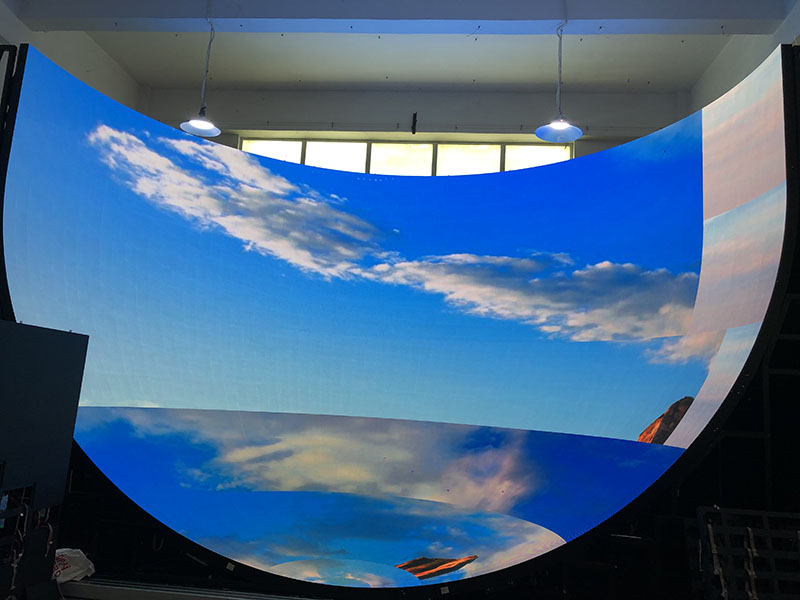
The immersive LED dome screen stands out with its unique concave structural design, with the screen curving inward, usually installed on top of a venue or building, like a giant LED dome. This design creates the illusion of being in a different place, especially when the audience looks up and feels a strong visual shock.
In addition, the immersive LED dome screen supports up to 22K Ultra HD resolution, far exceeding most projection solutions, while displaying rich colors and amazing brightness, bringing unprecedented vividness and detail to images and videos.
Its lightweight screen design also makes it ideal for hanging installations, providing flexible and versatile visual solutions for a variety of scenarios. So how can you build an immersive LED video display?
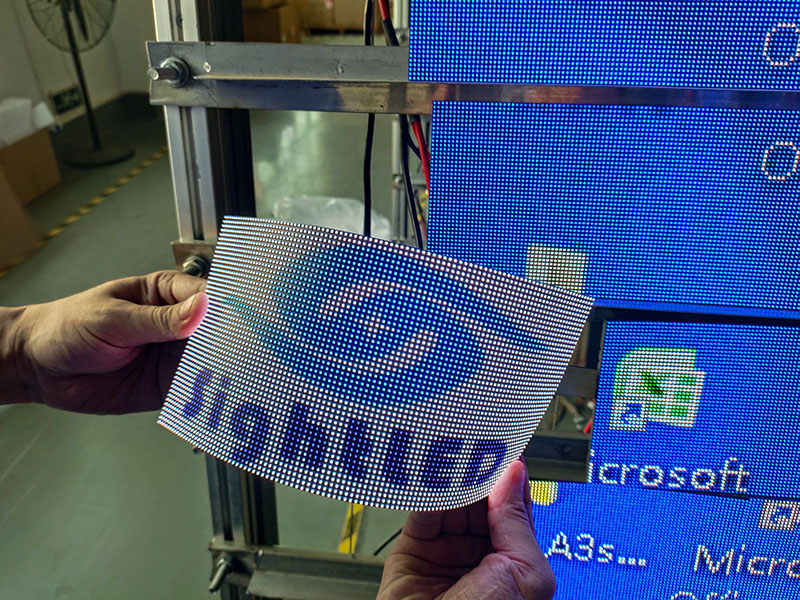
LED display screen as an important carrier to realize immersive experience, its design and application is in the spotlight. To create a stunning and immersive LED panel ,it not only requires a deep understanding of the technology, but also needs to find the perfect balance between creativity, aesthetics and practicality. Below, we will discuss how to carefully plan and design an immersive LED display.
Determine the installation location and space requirements
First of all, you should clarify the installation location of the 3D LED video wall, for example: consider the actual conditions of the site, such as the size of the space, structural layout, load-bearing capacity and the surrounding environment. At the same time, you also need to determine the optimal size and shape of the screen according to the expected visual effect and the purpose of use (e.g., commercial advertisement, live broadcast of sports events, stage performance, etc.). For example, in a large shopping center, a curved or ring-shaped LED screen can better attract customers’ attention and create a strong shopping atmosphere; while in the concert site, you may need a large size of the straight screen to ensure that all the audience can enjoy the stunning visual effects.
Consider the audience’s perspective and lighting conditions
The audience’s viewing experience is a factor that cannot be ignored when designing an immersive LED screen. Make sure that the installation position and angle of the screen can maximize the audience’s line of sight to avoid visual dead spots. In addition, you need to consider the surrounding lighting conditions. In outdoor or indoor environments with strong light, you should choose LED displays with high brightness and anti-light interference characteristics. While in the low-light environment, you can adjust the screen brightness and color temperature to create a more warm or mysterious atmosphere.
Choose the right pixel density
Pixel density is directly related to the clarity and detail of the LED display. Generally speaking, the closer the audience is to the screen, the higher the pixel density required to ensure that the picture is fine and grain-free. Conversely, if the audience is farther away, the pixel density can be appropriately reduced to reduce costs. Therefore, at the early stage of design, you need to accurately calculate and select the appropriate pixel density according to the specific location of the viewer and the expected viewing distance. If you use it for indoor use, you can give priority to SightLED P2.5 Flexible LED Module.
Choose reliable brands and suppliers
When you choose LED display, you should prioritize well-known brands and reputable suppliers. For example, SightLED has advanced production technology, strict quality control system and perfect after-sales service system. They are able to provide you with high quality and reliable products.
Innovate and customize exclusive visual experience
Customization and innovation are indispensable elements in the process of creating immersive LED screens. By combining project requirements and creative ideas, you can choose an LED display supplier with customization capabilities, such as SightLED.
We can customize the screen size, shape, resolution, color and other parameters according to your actual needs. At the same time, you can also take advantage of the flexibility and programmability of the LED display. Combined with lighting, sound, smoke and other special effects elements, to create a rich variety of visual effects and interactive experience. For example, in a concert, you can create a fantastic live atmosphere through the perfect combination of XR LED screen and stage performance.
We create a variety of immersive AR LED screens mainly through flexible LED modules and XR LED screens, you can get the following benefits.
| Advantages | Description | Sight LED Flexible Modular Design | XR LED Screen Features |
|---|---|---|---|
| Modular Design | Allows easier and more convenient assembly and installation. | utilizes modular LED panels that can be arranged like puzzle pieces, enabling the creation of custom-shaped screens with high flexibility. | Modular design also applies to XR LED screens, allowing for easy expansion and reconfiguration based on specific needs. |
| High Flexibility | Offers versatility in shape, form, and usage. | Our flexible LED modules that can bend and conform to irregular surfaces, enhancing the immersive experience. | XR LED screens leverage advanced technology to create seamless virtual environments that blend seamlessly with real-world objects, providing unparalleled flexibility in design and content creation. |
| Unlimited Possibilities | Limited only by creativity and imagination. | With Sight LED’s flexible modular design, users can create immersive spaces tailored to their specific vision, turning fantasies into reality. | XR LED screens push the boundaries of what’s possible, allowing for the creation of hyper-realistic virtual environments that defy traditional limitations. |
| High-Definition Visuals | Showcases high-quality HD visuals for a realistic experience. | high resolution and refresh rates, ensuring images and videos are detailed and authentic, even up close. | XR LED screens utilize cutting-edge display technology to deliver stunning visuals with unparalleled clarity and depth, enhancing the immersive experience. |
| Seamless Splicing | Creates an undivided, integrated display. | seamless splicing technology ensures that modular panels blend seamlessly, creating a cohesive and immersive viewing experience. | XR LED screens incorporate advanced stitching and blending algorithms to ensure a seamless transition between virtual and real elements, creating a unified and immersive world. |
| Immersive & Interactive Experience | Creates a virtual experience without the need for VR/AR tools. | curves and shapes, combined with high-quality visuals, trick the human vision and brain, providing a deeply immersive experience. | XR LED screens go beyond traditional displays, allowing for interactive experiences that engage all senses, further enhancing immersion. |
| Cost-effective with Real-time Productions | Reduces costs in film and TV production. | Our LED screens can be used to create multiple sets within the same space, eliminating the need for expensive set changes, reducing production costs. | XR LED screens enable real-time production capabilities, allowing for quick and cost-effective changes to virtual environments, further streamlining the production process. |
| Easy to Use and Control | Simple programming and operation with control panel. | Sight LED screens are typically controlled via a user-friendly control panel, enabling seamless content management and updates. | XR LED screens often incorporate intuitive control interfaces that allow for easy integration with motion trackers and dynamic cameras, enhancing usability and control. |
Our flexible LED module features:
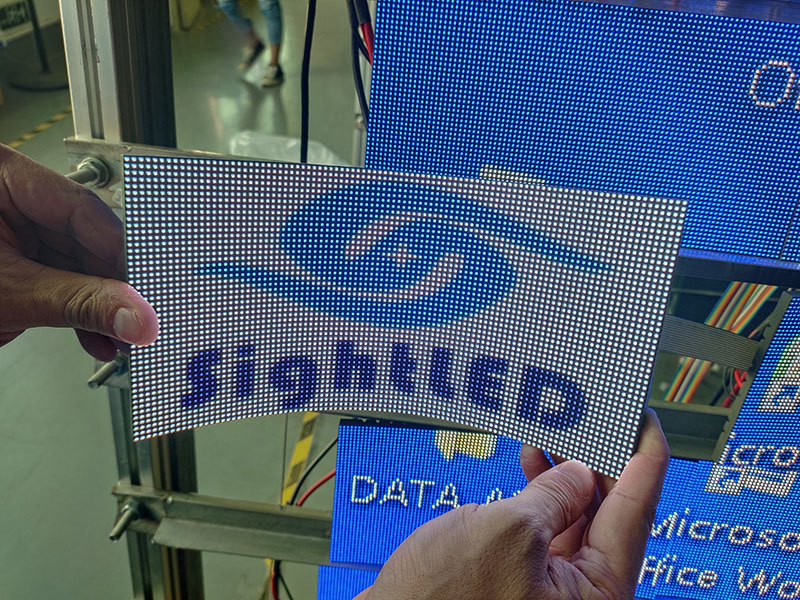
(1) High-quality soft flexible LED module panel
(2) Soft LED module frontal service maintenance design
(3) Any shapes LED display can be desighed
(4) Magnet Connection, easy to install and disassemble
(5) Low Brightness, High Grayscale
CE, Rohs Approved
(6) 3-Year Warranty and 5% Spare Part
China Flexible LED Display Modules Manufacturer
Immersive LED display often need to be customized according to specific scenarios and needs, including size, shape, resolution, brightness, etc., so the Immersive LED display price will vary greatly. However, immersive LED screens are basically made of flexible LED dsiplay modules. Therefore, P2.5 small-pitch immersive LED screens is about US$1,200-2,000 per square meter, while medium-pitch immersive LED screens (such as P3, P4) is about US$1,000-1,500 per square meter.
If you have specific needs, please contact us directly for more accurate quotes and customization solutions.
As an innovative display technology, immersive LED video screen have been widely used in many fields and bring people richer visual and interactive experiences. If you want to build these screens, please understand that it is a complex and delicate task that requires comprehensive consideration of many aspects.
If you’re not sure how to get started, why not contact SightLED? As a professional immersive LED screens provider, we can help you consider all aspects of the process to create an immersive LED screen. It will meet practical needs and has a unique appeal. If you need help, contact us now.