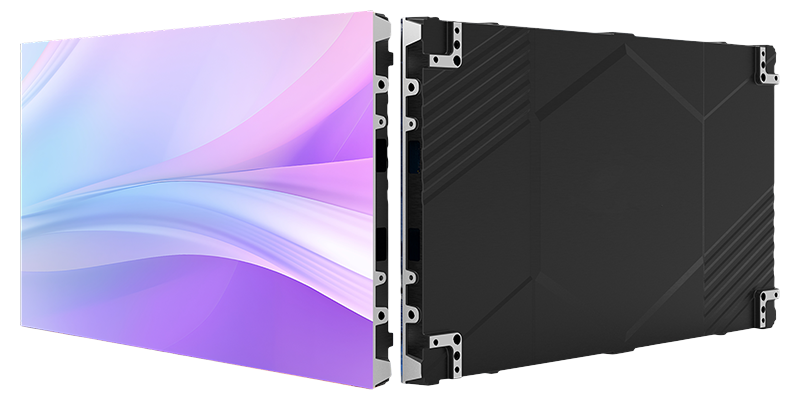
As the industry data for the first quarter of 2025 comes to light, the LED display industry reveals a clear and seismic shift. Specifically, SMD’s market share has slipped by 2 percentage points year-on-year to 77.6%. Meanwhile, COB and MiP technologies have continued their upward trajectory:
- Capturing 22.1% and 0.3% of the market share by sales
- With COB alone surging by an impressive 2.2 percentage points.
Behind these numbers lies a quiet yet profound technological revolution. Once the dominant force in the industry, SMD is now facing mounting pressure from the dual rise of COB and MiP. This transformation is not merely a shift in technological approaches but a fundamental restructuring of the entire industry chain.
Technological Breakthroughs: From Physical Limits to Performance Leaps
COB technology has fundamentally disrupted the traditional SMD production process. This integrated design eliminates the need for individual encapsulation and surface-mounting steps. More crucially, it overcomes the physical limitations of SMD in small-pitch applications.
Due to its single-pixel-per-package structure, SMD faces insurmountable technical barriers in markets below P1.2. Hoever, COB effortlessly achieves ultra-fine pitches below P1.0. For instance, in the high-end all-in-one conference display sector, COB has become the preferred choice. Additionally, its soft light output and touch resistance are qualities that SMD LED display.
Equally noteworthy is COB’s breakthrough in reliability. The notorious “caterpillar effect” in traditional SMD displays.
- Visual distortions caused by uneven pixel spacing
- It has been entirely eradicated with COB technology.
As a result, COB has rapidly gained traction in scenarios demanding high display consistency, such as command centers and XR virtual production. On the other hand, MiP technology, leveraging flip-chip designs and mass transfer techniques, demonstrates even greater competitiveness in the micro-pitch domain. Its tight chip-to-substrate connections enhance both resolution and display quality while streamlining testing processes, thus lowering the barriers to mass production. In markets below P0.9, for example, MiP’s resistance to ion migration and ultra-high pixel density have driven breakthroughs in applications like high-end cinema screens and virtual production.
A leading manufacturer’s MiP product, integrated with MicroIC has achieved remarkable performance metrics:
- Improving 1600cd/m² brightness and 95% DCI-P3 color gamut
- directly rivaling traditional LCD displays.
Although SMD manufacturers have made strides in small-pitch performance through technologies like IMD, they still struggle to compete with COB in markets above P1.5. More critically, SMD’s cost-reduction potential in micro-pitch applications has nearly reached its limit. Achieving pitches below P1.2 requires investment in higher-precision production equipment, driving maintenance costs far beyond those of COB.
This technological gap is particularly evident in cost-sensitive sectors like education and government applications. For instance, while SMD LED display P2.0-P1.7 pitch range remain relatively affordable, their display quality falls short.
Cost Restructuring: Breaking the High-Price Barrier Towards Mass Adoption

In Q1 of 2025, the average price of COB display dropped by 31.4% year-over-year. This dramatic cost reduction was mainly driven by improvements in supply chain maturity. By integrating the packaging and module production processes, the economies of scale associated with COB have substantially lowered its unit cost. For example:
- one manufacturer achieved a monthly COB production capacity of 51,000㎡ in 2024
- Expects to surpass 80,000㎡ in 2025
- further diluting marginal costs.
In the education sector, COB’s cost advantage is particularly evident. For below P1.5 display, COB conference all-in-one displays are now priced close to their SMD counterparts, while delivering significantly better image quality. As a result, their penetration rate in vocational and multimedia classroom renovation projects has surpassed 50%.
On the other hand, the MiP cost reduction has been more complex. Initially, mass production costs remained high due to immature mass transfer technologies. However, this changed fundamentally with the advancement of technologies like blue film output and 8-inch silicon-based substrates.
One leading LED packaging company, for instance, optimized its mass transfer process and significantly increased die yield per wafer, effectively reducing overall manufacturing costs. As a result, MiP P0.6–P1.6 LED display have quickly gained traction. In virtual production environments, MiP is increasingly replacing SMD in high-end applications thanks to its superior color and brightness uniformity. Although MiP prices are still higher than SMD, its total cost of ownership.
SMD’s cost challenges go beyond production. they’re also reflected in maintenance. In the government sector, for example, the average annual maintenance cost of SMD LED displa is significantly higher than COB. Under increasingly strict procurement regulations, this has become a fatal flaw.
In Q1 of 2025, SMD shipments in the government market fell sharply year-on-year, while COB shipments bucked the trend and gained a larger market share. Over time, this cost gap becomes more pronounced, further squeezing SMD out of mid-to-high-end applications.
Market Dynamics:
Despite growing challenges, SMD still holds an irreplaceable position in the mid-to-low-end market. Thanks to well-established supply chain and lower unit prices, SMD remains the mainstream choice for outdoor advertising and traffic signage In large-pitch above P2.0 application. For example, in the K12 segment of the education market, SMD LED display still dominate due to their affordability.
Moreover, SMD LED manufacturers are striving to stay competitive by improving their technology. Through innovations like virtual pixel technology, they are creating differentiated offerings in the P1.5–P1.8 LED display to slow the erosion of market share.
It’s important to note that COB and MiP are not in direct competition but rather complement each other, forming a synergistic ecosystem.
In commercial display applications, COB leads the mid-to-high-end from P1.2 to P0.9, while MiP carves out a niche in the ultra-fine pitch segment below P0.9. For instance, one LED display manufacturer offers COB-based conference all-in-one solutions in full sizes from 110 to 165 inches, while its MiP line focuses on high-end home theater displays under 80 inches.
By integrating COB for cost-effective base displays, using MiP to enhance local contrast and resolution, hybrid display solutions are now being deployed in use cases like command centers. It can increasingly diverse market demands.
In virtual production, SMD remains the mainstream solution for budget-conscious users. However, COB is emerging as the preferred choice for high-end film production. Meanwhile, MiP is gaining traction in ultra-high-precision shooting scenarios.
In education and conferencing, COB display P1.5–P1.2 now account for over 60% of the market share, while SMD has retreated to larger-pitch displays (P2.0 and above).
In home entertainment, MiP is making inroads in high-end displays and laser TVs under 100 inches due to its miniaturization and high integration, whereas COB is pushing into the consumer-grade commercial display.
The Next Decade:

Over the next ten years, the LED display industry will enter a new phase of transformation. As a result, the cost of COB and MiP solutions is expected to decline even further. By 2027, the average price of COB LED display will drop significantly, while P0.6 MiP price likely to approach current SMD levels.
This democratization of pricing will accelerate the penetration of advanced display technologies into emerging application. For instance,COB is rapidly growing in the digitization of surgical teaching systems, while the MiP is becoming indispensable for AR-HUD displays in intelligent cockpits.
One of the most notable trends is the hybrid COB+MiP architecture. By leveraging COB for foundational display and MiP to enhance localized performance, this approach has already been adopted in high-end command centers,. Because contrast ratios exceeding 10,000:1 are now achievable.
In parallel, glass-based and PCB-based technologies are advancing in complementary directions. Glass-based COGtechnology with active-matrix (AM) drive is proving ideal for ultra-large video walls, while PCB-based COB retains its cost advantage in small-to-medium-size displays.
Meanwhile, intelligent and data-driven upgrades are reshaping product capabilities. AI-powered pixel engines have enabled up to 40% reductions in power consumption for COB products, while supporting real-time image quality optimization.
Across the industry, upstream chip manufacturers are accelerating their shift toward Mini and Micro LED production. In the midstream, LED packaging companies are pursuing vertical integration to gain stronger bargaining power. By developing in-house flip-chip designs and mass transfer equipment, they are significantly improving MiP production yields and driving down manufacturing costs.
At the same time, downstream applications are increasingly demanding customized, turnkey solutions.
The erosion of SMD’s market share by COB and MiP is not merely a result of competition, but rather the outcome of a deeper resonance between technological progress and evolving market demands. Although SMD will likely maintain a presence in the mid-to-low-end , its dominance has been fundamentally shaken.
Conclusion:
Looking ahead, the LED display industry is expected to evolve into a three-tier structure:
- SMD as the legacy base
- COB occupying the mainstream middle ground
- MiP leading innovation at the high end.
In this new landscape, technological convergence and ecosystem restructuring will be the keys to unlocking future breakthroughs. As a top manufacturer, we have excellent COBLED display screens, if you need, you can feel free to contact us.