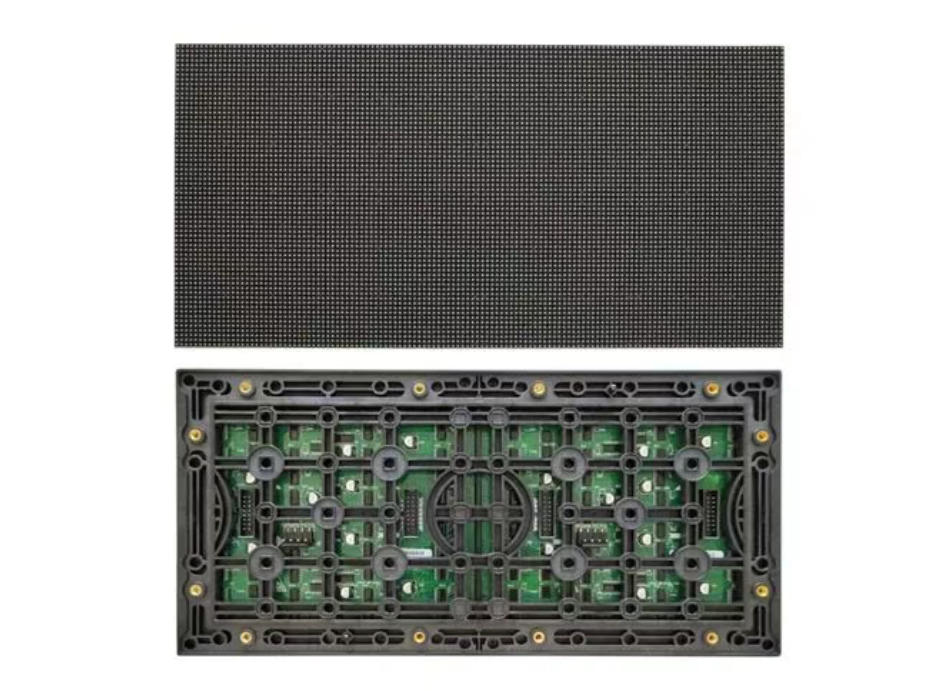
With the rapid development of the cultural tourism industry, giant dome flying Cinema have become a new favorite for scenic spots and commercial complexes to attract visitors. Many investors and cultural tourism practitioners are curious: How much does it cost to invest in a flying dome LED Cinema? What are its configuration requirements? Today, Sight LED will provide you with the details.
What is a giant dome flying theater?
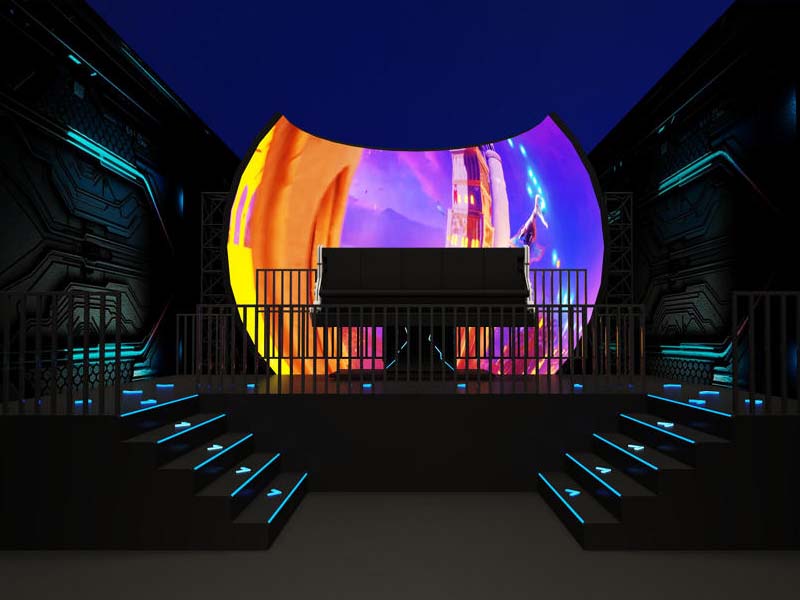
A giant dome flying theater, often referred to as an “air dome theater” or “flying dome Cinema,” is not a traditional theater, but rather a large-scale indoor entertainment project. Simply put, it combines “dynamic suspended seats + borderless dome screens + real-time special effects.” Audiences can completely break free from the limitations of “sitting in a seat and watching a screen” and achieve a truly immersive experience.
Why are Large dome flying Cinema so popular?
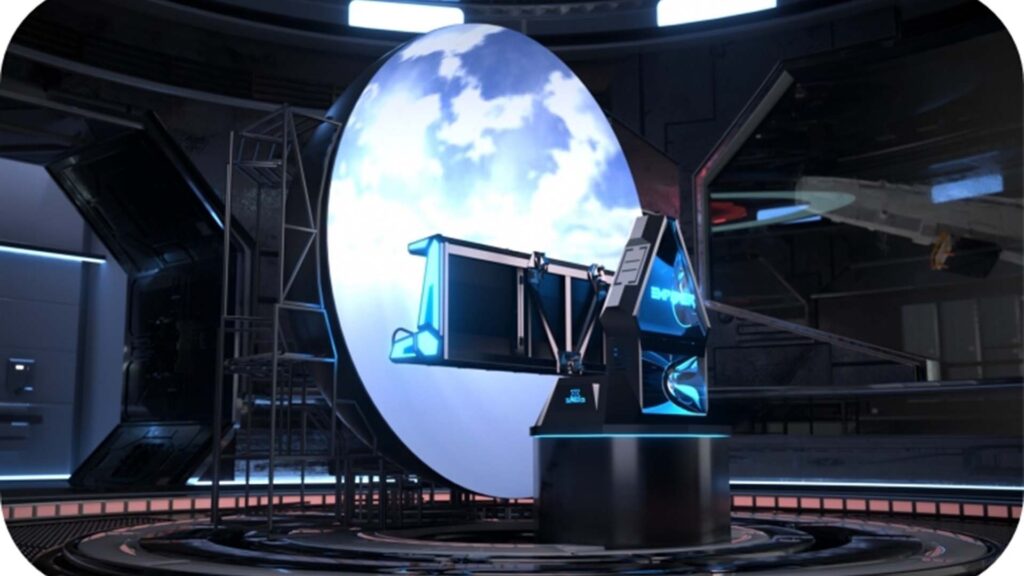
Why have giant dome flying Cinema become so popular in the cultural tourism market in recent years? The answer lies in their eight core advantages. They meet the operational needs of scenic spots while addressing the tourists pain points.
Technology sense
The giant dome flying theater’s core competitive advantage lies in its breakthrough “naked-eye 3D technology.” Visitors can experience realistic, three-dimensional scenes without wearing glasses.
Viral effect
In today’s era of the “check-in economy,” fresh and unique experiences are always a top priority for tourists. Large LED dome flying theaters are relatively rare. They inherently generate buzz: visitors can’t help but take photos and videos and share them on social media, creating a spontaneous “word-of-mouth” effect.
High-end positioning
For scenic spots, a high-quality, large-scale project not only attracts visitors but also enhances their overall positioning. The LED flying theater can accommodate a large number of visitors per session,such as 48-96 people per session, effectively accommodating large crowds and further enhancing the profitability of the scenic spot.
Highly immersive
Traditional cinema screens are flat, while the flying dome theater’s screen is circular. Regardless of the audience’s seat, they can see a complete, unobstructed view. Combined with multi-channel surround sound, it creates a double envelope, both visually and aurally. More importantly, it simulates lighting, sound, and image effects that are more realistic than reality.
Superb Experience
It utilizes a patented six-axis motion platform to accurately simulate acceleration, pitching, swaying, and sharp turns, allowing viewers to truly experience the thrill of “weightlessness,” “heavyness,” and “flight.” The experience is far more profound than simply visual stimulation and leaves visitors with an unforgettable impression.
High Safety
Many visitors have safety concerns about “flying attractions.” However, the dome LED flying Cinema eliminates these concerns. The entire “flying experience” takes place on the ground. There’s no actual liftoff required: the seats are suspended indoors, with multiple safety features. If visitors experience discomfort during the experience, simply close their eyes, and the discomfort will quickly disappear.
Full View
Ordinary surround screen Cinema may have “seamless” artifacts, which can affect the viewing experience. However, the large dome flying theater achieves “seamless, full view.” Whether the audience is sitting in the front or back row, left or right, they can clearly see the complete image from their respective perspectives, without any “screen interruptions” or “blind spots.”
Dynamic:
The advantages of dome LED flying theater are greatly magnified in scenes requiring “dynamics.” The dynamic seats’ movements are completely synchronized with the plot. For example, if the scene encounters a rapid, the seats will instantly “bump”; if the scene turns, the seats will synchronously “tilt.” As a result, the audience never feels disconnected, as if they are truly “moving along” with the plot.
What hardware and software does the dome flying theater system require?
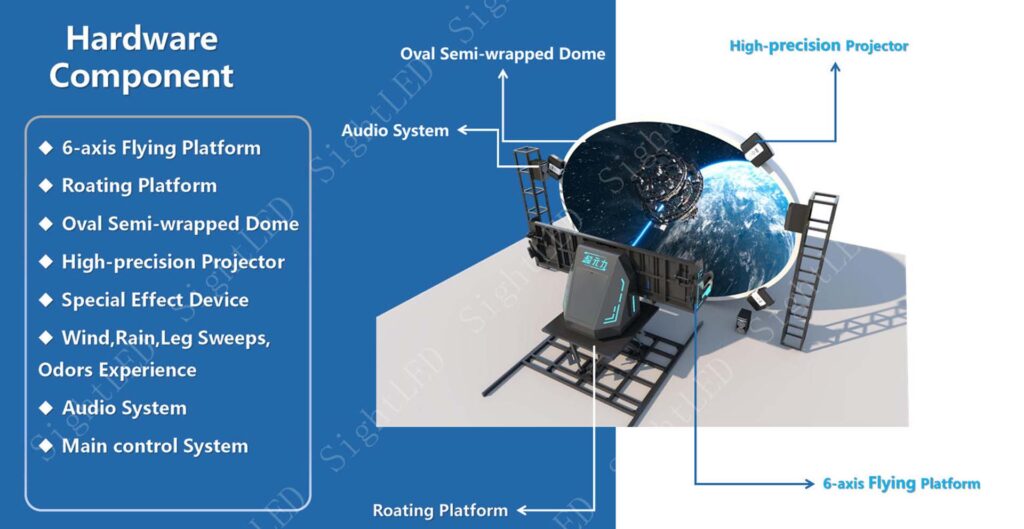
Achieving this breathtaking experience requires scientific equipment configuration and structural design. The LED dome flying theater configuration is primarily divided into “hardware system” and “structural design.”
Core Hardware Configuration:
The hardware configuration has five major systems, including “dynamic experience,” “visual effects,” “audio effects,” “special effects support,” and “content presentation.”
In addition to the five major systems mentioned above, you should also pay attention to some key parameters, such as:
Capacity per cabin:
8/10-person cabins are common, and multiple cabins can be combined depending on the venue size;
Dome Diameter:
16-18 meters for a 48-person experience or 23 meters for a 72/96-person experience. The larger the diameter, the more enveloping the screen;
Experience Duration:
5-8 minutes per session . Too long can cause fatigue, too short can be incomplete; 5-8 minutes is the optimal duration;
Accommodation Capacity:
6 sessions per hour, 48-96 people per session, and an hourly capacity of 288-576 people, effectively handling peak visitor traffic at the scenic spot;
Floor Area:
500-1000 square meters ,including the experience area, waiting area, and equipment area.
Seat Weight Capacity:
A single set of 8-seat integrated suspension seats has a net weight of 2.5 Tons. The venue must have a professional design institute calculate the load-bearing capacity of beams, columns, and floor slabs to ensure safety.
Structural Design
If the hardware is the “skeleton,” then the structural design is the “flesh and blood.” It determines the smoothness and safety of the experience.
Flying Seat Cabin:
The seat cabin is the area where the audience interacts directly. The design must address the three key requirements of “dynamic, safe, and comfortable”:
Range of Motion:
It allows for multi-dimensional movement, including forward and backward, up and down, left and right, and rocking.
Safety:
It utilizes an electric safety lever and seat belt, which cannot be opened manually.
Material and Special Effects:
The seats are made of high-quality fiberglass for durability and comfort. Special effects such as leg sweeps, scents, water sprays, and air jets are integrated to enrich the “physical experience.”
Deployment Method:
The cabin is deployed using a “cabin push-out” system. After the audience takes their seat, the front panel of the seat lowers, and the cabin is then launched by a track and suspended in front of the dome. The moment their feet leave the ground, the “flying sensation” is instantly maximized.
Suspension Platform:
The chairs’ stable suspension and complex movements are enabled by the “suspension platform” behind them.
Constructed of high-strength steel that meets national standards, it can be constructed in multiple levels (depending on the venue’s height and reception requirements).
All structures undergo rigorous load-bearing calculations and fully comply with building load-bearing standards.
The platform also integrates the chair’s power system (six-degree-of-freedom electric cylinder servo control) and slide system, ensuring precise and smooth movement.
Hemispheric Screen Structure:

The dome is the core of the visual experience.
Base Material:
The steel structure provides excellent stability and load-bearing capacity.
Screen Material:
Perforated aluminum sheet with a matte metallic paint finish for high gain and clear imaging.
Special Treatment:
Metallic projection paint is applied to the aluminum surface for better color and detail reproduction. The dome is vertically positioned at 90 degrees to the ground, maximizing the sense of wrapping around the image.
Seamless Design:
Precisely crafted for seamless, full-view viewing, eliminating image breakage that impacts the experience. Interior and Exterior Design:
In addition to the core structure, the design of the interior passageways and exterior exteriors is also crucial:
Interior passageways:
Carpeted floors (to reduce noise) and lighting strips (to create an ambiance); ceilings and walls painted black (to prevent glare that affects the viewing experience); and auxiliary lighting on the cabin roof for easier seating and evacuation.
Exterior:
A sci-fi, minimalist design style is typically employed, in line with the project’s themes of “flight” and “technology,” becoming a visual symbol of the scenic area.
Entrance queue areas:
Designed with a sense of ceremony, these areas can incorporate themed decorations and pre-show footage (using small screens to play plot clips to immerse visitors in the atmosphere). This makes the “wait” a pleasant experience and reduces the frustration of waiting in line.
How much does the dome flying theater system cost?

After reviewing the advantages and features, you may be wondering how much it costs to build a giant dome flying theater? Because project scale, equipment brand, and venue location vary widely, we’ll use a 20-meter diameter hemispherical flying theater as an example. It is the mainstream market specification and can accommodate 50-60 people per show and an hourly capacity of 300-360 people.
The total one-time investment budget is about $710,000~2.14 million.
This one-time investment primarily includes five major components:
- equipment purchase
- venue rental and renovation
- film copyright and customization
- design and construction
- preliminary procedures
1. Equipment purchase: $430,000~1.14 million (the largest component)
Equipment is the project’s core asset, and price differences primarily stem from brand and configuration level. It can be divided into four components:
Display system (dome + projector + server):
As the core of the core, the LED display system accounts for the largest portion of the cost. For a 20-meter diameter hemispherical theater, the screen area is approximately 300 square meters:
If you use a mid-to-high-end LED inner dome, such as SightED, the price per square meter is $1,430~2,140. Therefore, the dome alone costs $430,000~640,000; including the projector and server, the total cost is approximately $500,000~710,000.
If you use a standard projection dome, the cost is relatively low, with the dome + projector + server costing approximately $210,000~360,000, but the display quality will be inferior to that of an LED dome.
Dynamic seating system:
It can be calculated based on 50 seats, such as five 10-person cabins, the price per seat varies greatly depending on the degree of freedom and comfort:
Six-degree-of-freedom seats: $1,430~2,860 per seat, for a total cost of $70,000~140,000.
Eight-degree-of-freedom seats: $2,860 to 4,290 per seat, for a total cost of $140,000 to 210,000.
Sound and Special Effects Systems:
Sound System: It requires 7.1 or 9.1-channel surround sound, amplifiers, audio processors, etc. The total cost is approximately $43,000 to 71,000.
Special Effects System: Wind effects, water sprays, scents, lightning, and other devices are included. A complete system costs approximately $29,000~57,000.
Total sound + effects cost: $71,000 to 129,000.
Ancillary Equipment: Includes seat tracks, consoles, security cameras, and other equipment. The total cost is approximately $29,000~57,000.
2. Venue: $140,000~570,000
Venue costs are divided into two parts: rental and renovation. The Price vary significantly between cities and locations.
Venue Rental:
Core business districts or popular scenic spots (500 to 1,000 m²): Monthly rent is approximately $29,000 to 71,000. For a minimum four-month lease, you nned pay about $114,000~286,000.
Second- and third-tier cities: Monthly rent is approximately $14,000~36,000, with an upfront payment of $57,000~143,000.
Scenic spots with own venues: Lease costs eliminated, only renovation required.
Site Decoration:
Standard: $290~710 per m², total cost for a 500 m² venue is approximately $140,000~360,000.
Extra pre-performance area or themed corridor: Additional $29,000~71,000.
3. Film Copyright or Customization: $29,000~143,000
High-quality films are key to attracting visitors to a flying theater.
Purchasing existing copyrights: A high-quality full-dome flying film costs approximately $29,000~71,000.
Customizing films: “Flying over XX scenic spot” requires professional teams, costing $71,000~143,000, with a 2~6 month production cycle.
4. Design and Construction: $43,000~114,000
Design fee: $14,000~29,000
Construction and commissioning fee: $29,000~86,000
Total: $43,000~114,000
5. Preliminary Procedures: $14,000~43,000
Includes business license application, fire inspection, and equipment testing.
Ongoing operating costs: $140,000~430,000 per year
After the initial investment, annual operating costs include:
Staff Expenses:
5~8 employees. Total annual salary $51,000~103,000.
Marketing and Promotion:
Monthly $7,000~21,000, annual $86,000~257,000.
Energy Consumption and Maintenance:
Electricity: Monthly $2,900~7,100.
Maintenance: $7,100~21,000 annually.
Combined annual cost: $41,000~107,000.
Film Updates:
Every 1~2 years, cost $29,000~71,000 annually.
Cost Summary
- Initial investment: $710,000~2.14 million
- Annual operating costs: $140,000~430,000
Note:
If you choose higher-end equipment, such as imported six-degree-of-freedom chairs, 4K laser projection, a prime location, or multiple exclusive films, costs could exceed $2.85 million.
If you choose cost-effective equipment, build at a scenic spot’s own venue in a second- or third-tier city, or purchase existing film rights, the cost can be kept within $710,000~1.14 million.
Summary:
From a market perspective, with people’s growing interest in “immersive entertainment,” large dome flying theaters are a promising asset in the cultural tourism market. They can become a scenic spot’s “IP symbol,” enhancing its overall positioning; they can also leverage their influence as influencers to generate organic buzz and reduce marketing costs. However, the initial investment is substantial.
If you are planning a scenic spot upgrade or commercial complex attraction project, you can consider a dome flying theater. If you require more specific specifications and pricing , please feel free to contact us.