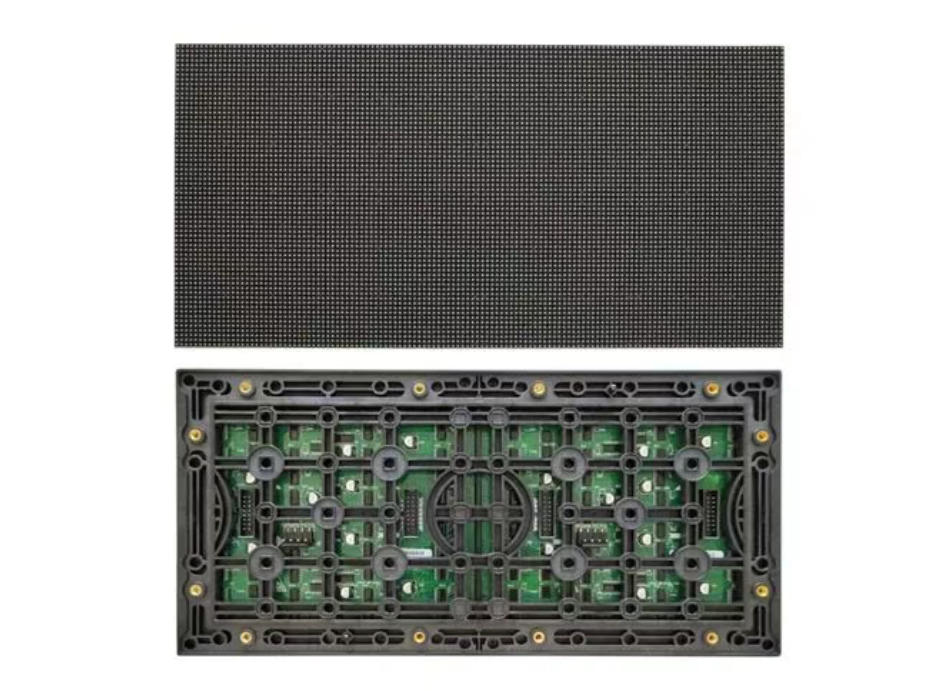
LED display technology has been widely used for outdoor billboards and HD indoor screens. At its core is the concept of pixels. It directly affects resolution, cost, and applicability. But did you know? There are two basic approaches to LED display pixel technology:
- Real pixels
- Virtual pixels
Each approach uses different methods to drive pixels and has its own advantages and disadvantages.
Today, we will introduce you to the difference between real pixels and virtual pixels.
What are real pixels?
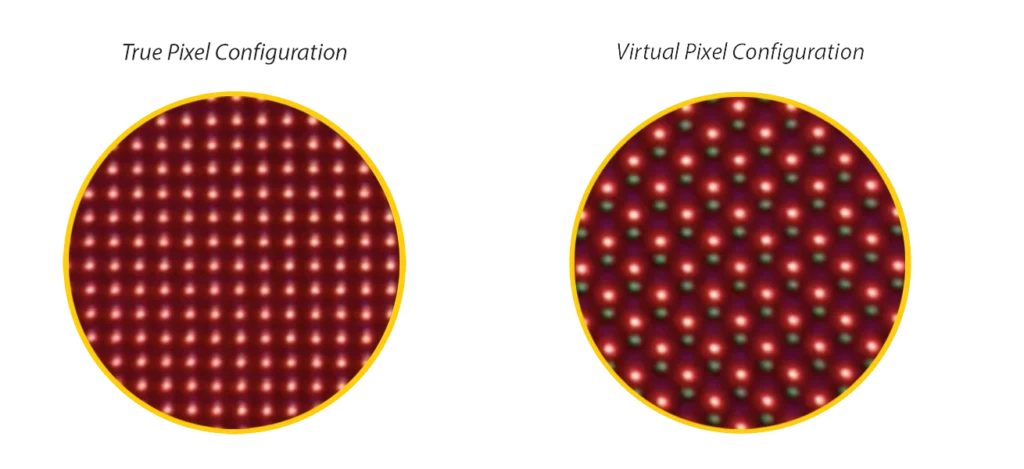
Real pixels are the most direct way to build LED displays. They operate in a one-to-one correspondence between physical pixels and display pixels.
Definition and composition
A real pixel is a physical unit on an LED display. It consists of red (R), green (G), and blue (B) LED diodes, which together form a pixel that can produce a full color spectrum. Typically, real pixels use a “1R1G1B” configuration. Each pixel consists of one red, one green, and one blue LED diode. In some high-brightness display applications, LED screen manufacturers may use a “2R1G1B” configuration to enhance brightness, such as in outdoor displays under direct sunlight.
The true pixel display resolution is directly related to its number of physical pixels. For example, if a display has 1920 physical pixels horizontally and 1080 physical pixels vertically, its resolution is 1920×1080, which is equivalent to about 2.07 million pixels or a “full HD” display. Each pixel operates independently and is driven by a dedicated control circuit to match the displayed image to the physical hardware.
Key Features
True pixel displays are good for clarity and color accuracy application.
Pros:
- Excellent image quality: Because each display pixel corresponds to a physical pixel, images are clear and detailed even at close viewing distances (such as 1-2 meters). Therefore, true pixel displays are ideal for applications such as control rooms or conference halls.
- Accurate color reproduction: The direct emission of RGB diodes allows natural color mixing without relying on complex algorithms, so it provides consistent color tones and high fidelity.
- Reliable performance: True pixel displays require no pixel sharing or interpolation. As a result, a variety of content, whether text or high-resolution video, maintains consistent quality.
Cons:
- Higher cost: More physical LEDs are needed to achieve high resolution. This significantly increases manufacturing and material costs. For example, a 4K display (3840×2160) requires more than 8.3 million physical pixels. Each pixel requires three LED diodes, which undoubtedly increases the cost.
- Scalability Challenge: For large-scale displays, True pixel technology will be expensive and not suitable for limited budgets.
Ideal Applications
If the viewing distance is close to the screen, then true pixel displays are preferred. For example, P1.5 fine pitch LED displays can achieve resolutions exceeding 4K in a smaller area. In addition, they are able to present fine details without distortion.
What is a virtual pixel?
Virtual pixel technology takes a different approach. It enhances the perceived resolution without increasing the number of physical LEDs. Therefore, it is a cost-effective solution in large outdoor LED display projects.
Definition and Principle
Virtual pixels rely on a technology called sub-pixel multiplexing. That is, adjacent physical pixels share their red, green, and blue sub-pixels to create additional “virtual” pixels. This technology effectively increases the display resolution beyond its physical pixel count. For example, a LED display with 1000×1000 physical pixels may have an effective resolution of 2000×2000 virtual pixels, quadrupling the perceived pixel count.
It works by strategically arranging LEDs (usually in an interleaved or staggered arrangement) in conjunction with advanced drive algorithms. These algorithms control how sub-pixels are shared to form virtual pixels. For example, four physical pixels can produce up to 16 virtual pixels by recombining their sub-pixels. This results in a multiplication factor (usually 2x or 4x) that increases the effective resolution.
To put this into context, a P10 LED display panel with a physical resolution of 960×540 pixels, using virtual pixel technology with a 4x upscaling factor, would have an effective resolution of 1920×1080. This is equivalent to Full HD resolution without adding more LEDs.
Key Features
Virtual pixel displays are suitable for limited budgets and long-distance viewing, but there are some disadvantages:
Pros:
- Cost-effectiveness: It achieves higher effective resolution without the need for additional LEDs, reducing hardware costs.
- Enhanced perceived resolution: At typical viewing distances (e.g., 10-20 meters for outdoor billboards), the human eye cannot discern the synthetic properties of virtual pixels, resulting in a perceived sharper and more detailed display.
- Scalability for large displays: It enables large screens to maintain acceptable resolution without high costs.
Cons:
- Compromised viewing quality at close range: When viewed at close range, virtual pixels appear blurry or exhibit artifacts such as edge aliasing due to sub-pixel sharing. Therefore, they are less suitable for close-range indoor applications.
- Algorithm dependency: The quality of virtual pixels depends largely on the complexity of the driving algorithm. Poorly optimized algorithms can result in inaccurate colors or uneven brightness, which degrades the viewing experience.
- Reduced color accuracy: Because virtual pixels combine sub-pixels from multiple physical units, color mixing is not as precise as real pixel displays.
Ideal Applications
Virtual pixel displays are good for outdoor environments with long viewing distances, such as highway billboards, shopping mall facades, or public squares. For example, a P16 virtual pixel technology display can present visually impactful images at distances of more than 30 meters.
In addition, Thanks to high cost-performance, it is a practical choice for those who need a large screen but have a limited budget.
Technical Parameter Comparison
To better understand the actual difference between the two, let’s take a look at the following key technical parameters:
Pixel Pitch: P1.2-P2.5 small pixel pitch real pixel displays are common in high-definition indoor displays, with pixel densities as high as 1,000,000 pixels/m2. Virtual pixel P10-P20 displays with larger pixel pitches can achieve similar perceived density, usually with effective density between 2,500 and 10,000 pixels/m2.
Resolution: The resolution of a real pixel display matches its physical pixel count, for example, 2.07 million pixels corresponds to 1920×1080.
Virtual pixel displays can double or even quadruple the resolution, for example, a physical pixel of 1920×1080 can achieve an effective resolution of 3840×2160.
Brightness: Since each pixel is equipped with a dedicated RGB diode, real pixel displays are generally able to achieve higher brightness. Virtual pixel displays sacrifice some brightness to improve resolution, usually between 5,000-7,000 nits.
Cost per square meter: P1.2-P2.5 small pitch real pixel displays cost $1,000-3,000/square meter, while virtual pixel displays cost much less. Large pitch displays usually cost $700-1,200/square meter.
Viewing distance: The minimum viewing distance supported by real pixels is as low as 1 meter, while virtual pixels are best viewed at a distance of 10 meters or more due to their synthetic nature.
How to choose between real pixels and virtual pixels?
The choice between real pixels and virtual pixels depends on your project needs:
You can choose real pixels when:
- You need high-definition visuals at close range, such as in a control room, retail display, or broadcast studio.
- You care about color accuracy and detail, such as in medical or design applications.
- You have a large budget and can afford the higher cost.
You can choose virtual pixels when:
- You are designing a large outdoor display, such as a billboard or stadium screen. The audience is more than 10 meters away.
- Your budget is limited.
- In the field of advertising or public signage, perceived resolution is more important than absolute clarity.
The future of pixel technology
As LED display technology develops, the gap between real pixels and virtual pixels is narrowing. Thanks to the advancement of Micro-LED and Mini-LED technology, Below 1mm small-pitch real pixel displays are becoming more and more affordable. For example, a P0.9mm Micro-LED display can achieve 8K resolution (7680×4320) on a 110-inch panel. Its resolution is comparable to traditional LCD displays.
Meanwhile, virtual pixel technology has been continuously improved through more advanced algorithms and driver chips, which improves color accuracy and reduces artifacts. Nowadays, hybrid approaches combining real pixel and virtual pixel technologies are also emerging, providing a balanced solution for mid-range applications.
Conclusion
There is no absolute better between real pixel and virtual pixel LED displays. They depend on your project needs. As a top LED display manufacturer, we provide high-quality LED displays, if you need, feel free to contact us.