When selecting the perfect LED screen size for a 4K or 8K display, there are several important factors to consider. In this guide, we will explore how to pick the right screen based on pixel pitch.
Understanding LED Pixel Pitch and Resolution
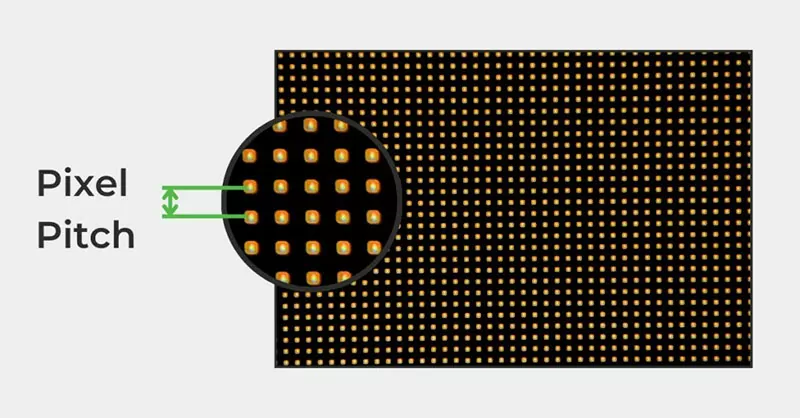
Pixel Pitch refers to the distance between the center of one LED cluster to the next. The smaller the pixel pitch, the higher the resolution, and the closer the audience can stand to the screen while maintaining clarity.
P3.9 to P0.9: The numbers in “P3.9” or “P0.9” represent the distance in millimeters between pixels. A smaller number indicates a higher density of pixels and, thus, a clearer image at closer viewing distances.
Resolution is measured in terms of pixel count (width x height). For 4K resolution, you need a screen with at least 3840×2160 pixels. For 8K, the resolution jumps to 7680×4320 pixels.
If you want to quickly know how much area is required for different pixel pitch, please check the following list.
Now, let’s break down the required area for each resolution based on the different pixel pitches:
| Resolution & Pixel Count | P0.8 (m²) | P1.0 (m²) | P1.2 (m²) | P1.3 (m²) | P1.5 (m²) | P1.6 (m²) | P1.8 (m²) | P2.0 (m²) | P2.5 (m²) | P3.0 (m²) | P4.0 (m²) | P5.0 (m²) | P6.0 (m²) | P8.0 (m²) | P10 (m²) |
|---|---|---|---|---|---|---|---|---|---|---|---|---|---|---|---|
| 720P (1280×720) | 0.82 | 1.024 | 1.44 | 1.75 | 2.18 | 2.56 | 3.19 | 3.69 | 6.14 | 8.85 | 15.07 | 23.55 | 33.91 | 58.98 | 92.16 |
| 1080P (1920×1080) | 1.84 | 2.15 | 3.24 | 3.95 | 4.91 | 5.76 | 7.18 | 8.29 | 13.06 | 18.80 | 33.42 | 52.22 | 75.20 | 132.71 | 208.89 |
| 4K (3840×2160) | 6.76 | 8.60 | 12.96 | 15.78 | 19.63 | 23.04 | 28.71 | 33.18 | 52.22 | 125.34 | 133.69 | 208.89 | 300.81 | 530.84 | 829.44 |
| 8K (7680×4320) | 27.03 | 33.18 | 51.84 | 63.12 | 78.52 | 92.16 | 114.84 | 132.72 | 208.89 | 501.35 | 530.84 | 829.44 | 1194.39 | 2123.37 | 3317.76 |
How to choose the Right LED Screen Size for 2K Display

A 2K resolution typically refers to 2048×1440 pixels, so the screen size will vary depending on the pixel pitch of the LED panels.
500mm*500mm LED panel
P2.9 LED Screen
For a P2.9 pixel pitch, you would need approximately 11×6 panels to achieve a 2K display. This would result in a screen size of 5.5 meters x 3.5 meters, with a total area of 19.25 square meters.
Application:
- medium or smaller events
- corporate meetings
- Auditoriums
- storefront displays.
P2.6 LED Screen
If you are using a P2.6 pixel pitch, you would need 10×6 panels to reach a 2K resolution. The screen size would be 5 meters x 3 meters, with a total area of 19.25 square meters.
Application:
- smaller meeting rooms
- churches, or exhibitions
P1.8 LED Screen
If you use A P1.8 pixel pitch,you need to require 7×4 panels to achieve a 2K resolution,and the screen size of around 3.5 meters x 2 meters, with a total area of 7 square meters.
Application:
- High-end exhibitions
- Small retail spaces.
604*340mm LED Panel
P1.2 LED Screen
With a P1.2 pixel pitch, you only 7×7 panels for a 2K display, and the size is about 4.23 meters x 2.38 meters, with a total area of 10.07 square meters.
Application:
- small control rooms
- conference spaces
604*675mm LED Panel
P0.9 LED Screen
For a P0.9 pixel pitch, you would need 3×3 panels to achieve a 2K resolution. The resulting screen would measure 1.81 meters x 1.02 meters, with a total area of 1.84 square meters.
Application:
- Museums
- high-end retail displays
- luxury showrooms.
How to choose the Right LED Screen Size for 4K Display
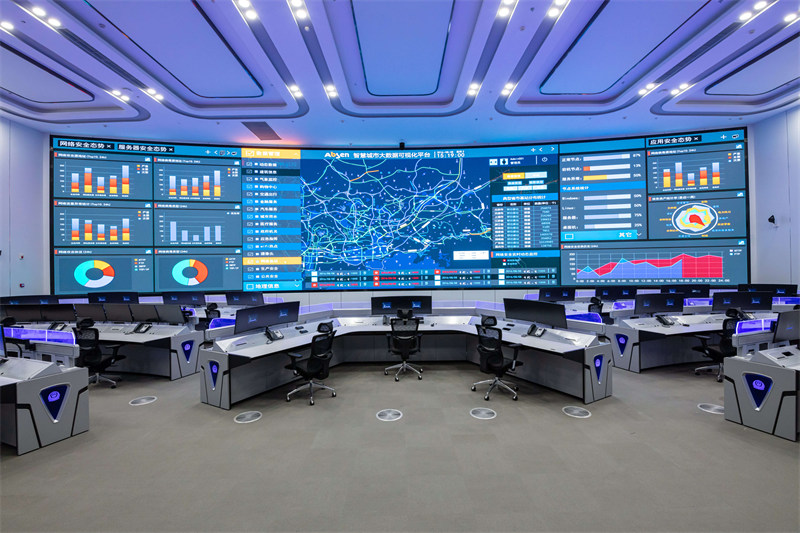
When aiming for 4K resolution, different pixel pitches require various screen sizes and configurations:
500mm*500mm LED panel
P3.9 LED Panels:
To achieve 4K resolution,If you use P3.9 pixel pitch, you need a configuration of 30×17 panels. This would result in a screen size of 15m x 8.5m, a total area of 127.5 square meters.
Application:
- large spaces like arenas
- concert halls
- outdoor events.
P2.9 LED Panels:
For P2.9, a 4K display requires 25×13 panels, creating a screen size of 12.5m x 6.5m. The total area is 81.25 square meters.
Application:
- Theaters
- Churches
- conference rooms
P2.6 LED Panels:
With P2.6, 4K resolution requires 20×12 panels, so the screen size is about 10m x 6m and a total area of 60 square meters.
P1.8 LED Panels:
For P1.8, you’ll need 14×8 panels and screen size of 7m x 4m, covering 28 square meters.
Application:
- meeting rooms
- retail stores .
1200*675mm LED panel
P1.2 LED Panels:
With a P1.2 pixel pitch, you only need 4×4 panels to achieve 4K resolution, so the screen size is about 4.8m x 2.7m and an area of 12.96 square meters.
Application:
- control rooms
- small conference rooms.
604*675mm LED panel
P0.9 LED Panels:
For the most detailed displays, you can use P0.9 pixel pitch, a 6×6 panel is enough for 4K. This gives a screen size of 3.63m x 2.04m and a total area of 7.4 square meters.
Application:
- luxury retail displays
- exhibitions.
How to Choose the Right LED Screen Size for 8K Display

8K resolution is the pinnacle of display quality. It offers twice the pixel density of 4K. The size and configuration of LED screens to achieve 8K are understandably larger.
500mm*500mm LED panel
P3.9 LED Panels:
For an 8K display, you will need 60×34 P3.9 panels, resulting in a screen size of 30m x 17m. The total area is 510 square meters.
Application:
- enormous outdoor events like concerts,
- large sporting events,
- huge digital billboards
P2.9 LED Panels:
With P2.9 pixel pitch, you would need 45×25 panels for an 8K display, resulting in a screen size of 22.5m x 12.5m and a total area of 281.25 square meters.
Application:
- large indoor events
- trade shows
- Exhibitions
- conventions
P2.6 LED Panels:
For P2.6, 8K resolution requires 40×24 panels, the screen size is about 20m x 12m and a total area of 240 square meters.
Application:
large events
P1.8 LED Panels:
For P1.8, an 8K display requires 29×15 panels,the screen size is about 14.5m x 8m, covering 116 square meters.
Application:
- large auditoriums
- convention centers
- high-end venues
1200mm*675mm LED Panel
P1.2 LED Panels:
With P1.2 pixel pitch, you’ll need 8×8 panels to achieve 8K resolution, and a screen size is about 9.6m x 5.4m and an area of 51.84 square meters.
Application:
control centers or museums
604mm*675mm LED panel
P0.9 LED Panels:
For P0.9 LED display, you can use 12×12 panels for an 8K display. The resulting screen size is 7.26m x 4.08m, with a total area of 29.6 square meters.
Application:
high-end exhibitions or presentations.
Factors to Consider Beyond Size
While screen size and resolution are key, there are other factors to consider when choosing an LED display for 2K, 4K or 8K viewing:
Viewing Distance: The smaller the pixel pitch, the closer viewers can be to the screen without losing clarity. For closer viewing environments, choose a lower pixel pitch.
Brightness and Ambient Light: Outdoor displays need higher brightness to compete with sunlight, while indoor environments require less. Please Make sure to select a screen that matches your environment’s light conditions.
Budget: smaller pixel pitches (e.g., P0.9 or P1.2) will be more expensive than larger pixel pitches (e.g., P3.9 or P2.9). Balance your resolution needs with your budget.
Installation Space: Make sure the area can accommodate the required size.
SightLED COB LED display solution recommendation
For different applications, the top COB LED display manufacturer-SightLED provides a variety of solutions:
Small pitch fixed installation COB Screen
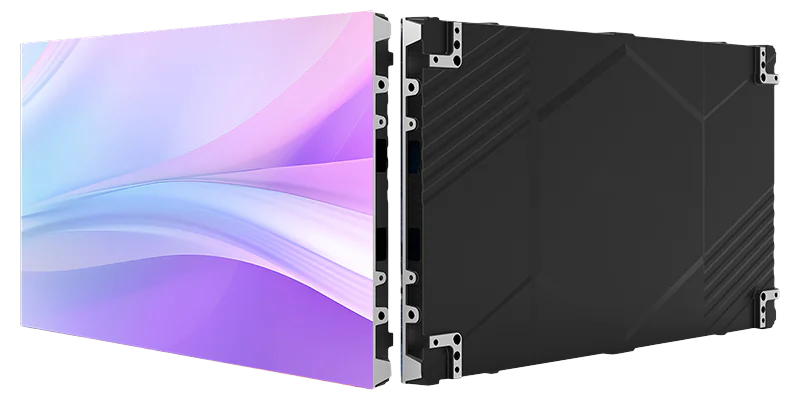
The COB small pitch fixed installation solution is suitable for application:
High resolution;
- High brightness;
- High contrast application
- High-end command centers;
- Radio and television studios, etc.
- SightLED Ultra series:
- P0.93 products support 7680Hz refresh rate
- Meet the needs of 8K/120fps film and television production.
At the same time, it adopts a 600×337.5mm standard size cabinet design and supports ±15° arc adjustment
It is convenient for users to splice and install according to actual needs.
View more our prodcut: Flip Chip COB LED Display
Typical case:
A TV station’s 4K studio uses a 576㎡ COB screen, which runs continuously for 20,000 hours without failure. This case fully demonstrates the excellent performance and stability of COB LED display screens in high-end application scenarios.
Mobile conference COB system

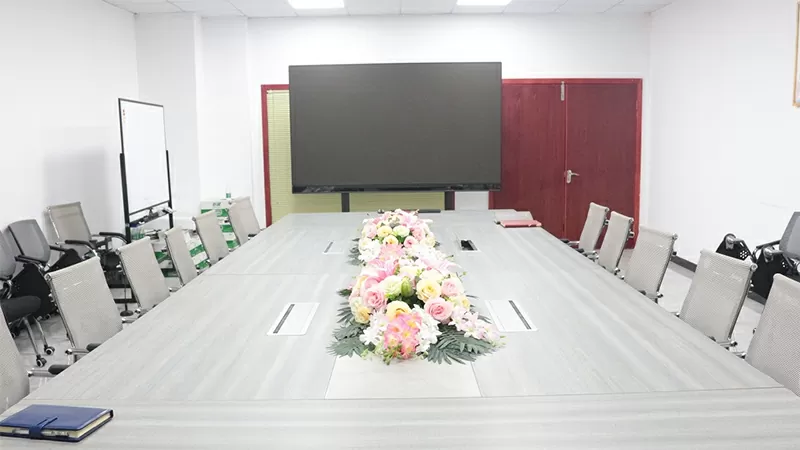
The mobile conference COB system is suitable for application:
- Flexible mobility;
- Rapid deployment;
- such as corporate conference rooms, temporary exhibitions, etc.
View more our prodcut: Movable & Foldable Conference LED Display
Conclusion:
We have guided you on LED screen size for 2K,4K or 8K depends on your pixel pitch. In general, 8K require more panels and larger sizes, but the exact configuration depends on the pixel pitch you select. If you are looking for an LED screen and don’t know how to choose, please feel free to contact us.
FAQs:
1. What does pixel pitch mean in an LED display?
Pixel pitch is the distance between two adjacent LED pixels in millimeters. Smaller pixel pitch has higher resolution, sharper images, and supports closer viewing distances.
2. How does pixel pitch affect screen size for 4K or 8K?
To reach 4K or 8K resolution, Smaller pixel pitch needs less physical screen size, while larger pitch requires a much bigger display area.
3. What resolution is considered 2K, 4K, and 8K?
2K is around 2048×1440 pixels, 4K is 3840×2160 pixels, and 8K reaches 7680×4320 pixels in total pixel count.
4. Why is pixel pitch more important than screen size?
Pixel pitch determines pixel density. Even a large screen cannot achieve true 4K or 8K clarity if the pixel pitch is too large.
5. Which pixel pitch is suitable for close-viewing indoor applications?
P0.9 to P1.5 are ideal for close indoor viewing, such as control rooms, studios, museums, and high-end retail spaces.
6. What pixel pitch is recommended for large venues?
For large venues or long viewing distances, P2.9 to P3.9 pixel pitch offers a good balance between resolution, brightness, and cost efficiency.
7. How many panels are needed for a 2K LED display?
The panel quantity depends on pixel pitch and cabinet size. Smaller pitch panels require fewer cabinets to reach 2K resolution.
8. Can a 500×500mm cabinet support a 4K LED wall?
Yes, but achieving 4K with 500×500mm cabinets requires many panels, especially with larger pixel pitches like P3.9 or P2.9.
9. Why do fine-pitch LED displays need less installation space?
Fine-pitch displays pack more pixels per square meter.
10. What pixel pitch is best for 4K indoor video walls?
P1.2 to P1.8 pixel pitch is commonly used for 4K indoor video walls. They offer high resolution, smooth images, and manageable installation size.
11. Is P0.9 necessary for 4K resolution?
P0.9 is not mandatory but ideal when extremely high pixel density, close viewing distance, and premium visual quality are required.
12. How does cabinet size affect resolution planning?
Cabinet size defines pixel layout and panel count. Larger cabinets reduce seams and simplify installation but require precise resolution calculations.
13. What is the advantage of COB LED for small pixel pitch?
COB LED provides higher contrast, better heat dissipation, improved durability, and reduced dead pixels. Therefore, it is ideal for P0.9–P1.2 applications.
14. How does viewing distance influence pixel pitch selection?
Viewing distance determines the smallest acceptable pixel pitch. Shorter distances require finer pitch to avoid visible pixelation.
15. Why does 8K require significantly more panels than 4K?
8K has four times the total pixels of 4K. It requires either much finer pixel pitch or a substantially larger screen area.
16. What pixel pitch is practical for 8K indoor displays?
For indoor 8K displays, P0.9 to P1.2 pixel pitch is most practical, balancing resolution, screen size, and system complexity.
17. Are large pixel pitches suitable for 8K displays?
Large pixel pitches like P3.9 can achieve 8K only with extremely large screens. Therefore, they are suitable for stadiums or outdoor billboards.
18. How does brightness affect resolution choice?
Higher brightness is essential for outdoor or high-ambient-light environments, but brightness must be balanced with pixel pitch and viewing distance.
19. What role does refresh rate play in high-resolution displays?
High refresh rates, such as 7680Hz, are critical for 4K and 8K filming, broadcasting, and motion-heavy content without flicker or scan lines.
20. Why is installation space a critical planning factor?
Insufficient installation space may prevent achieving target resolution, especially for larger pixel pitches.
21. How does budget influence pixel pitch selection?
Smaller pixel pitch significantly increases cost due to higher LED density, advanced manufacturing, and stricter quality control requirements.
22. Are curved LED walls compatible with fine pixel pitch?
Yes, our fine-pitch LED cabinets support arc adjustments. It can support curved 4K or 8K LED walls for immersive viewing environments.
23. What applications benefit most from mobile COB LED systems?
Mobile COB systems are ideal for temporary conferences, exhibitions, and events. It can be fast deployment, high resolution, and frequent relocation.
24. How should I start planning a 2K, 4K, or 8K LED display?
You can begin by defining viewing distance, target resolution, installation space, and budget, then select the appropriate pixel pitch and cabinet size accordingly.