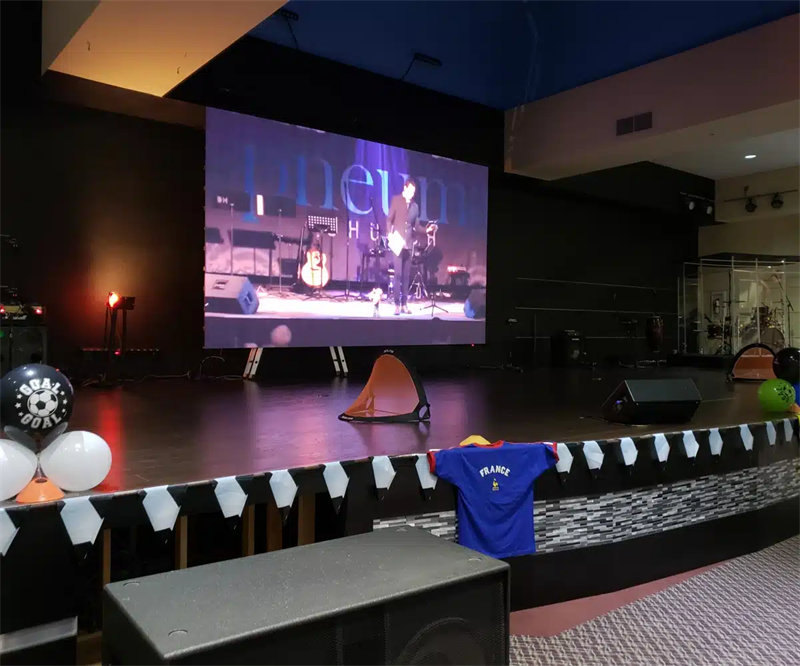
More and more places are pursuing immersive visual experiences, from large command centers and luxurious commercial showrooms to high-end home theaters. So, how can you miss a seamless, vibrant, and colorful 4K LED video wall?
Gone are the high prices of the past, and it’s no longer out of reach for specialized equipment. But are you curious about how to create such a stunning giant wall? SigtLED will explain the details.
What is a 4K LED display wall?

Simply put, a 4K LED video wall is composed of multiple LED display cabinets seamlessly connected like Lego blocks. Its physical resolution reaches or exceeds 3840×2160 pixels. However, it’s far more than simply scaling up a TV; it’s a complex, engineering-grade audio-visual solution. To understand it, we can consider three key aspects:
“4K”
“4K” refers to its physical resolution. The display wall has at least 3840 pixels horizontally and at least 2160 pixels vertically.
Total number of pixels: 3840 × 2160 = 8,294,400 (over 8.3 million pixels)
“LED” – Advanced Display Technology
It uses light-emitting diodes as the light source, fundamentally different from the LCD technology used in home televisions.
Self-luminous properties: Each red, green, and blue sub-pixel can emit light independently, enabling extremely high contrast levels.
Excellent performance: Brightness typically reaches over 800-1000 nits. It can overcome ambient light interference. Moreover,it can also offer a wide color gamut, display richer colors, and achieve high refresh rates.
Modularity and seamless stitching
This is its most fundamental difference from ordinary single-unit displays.
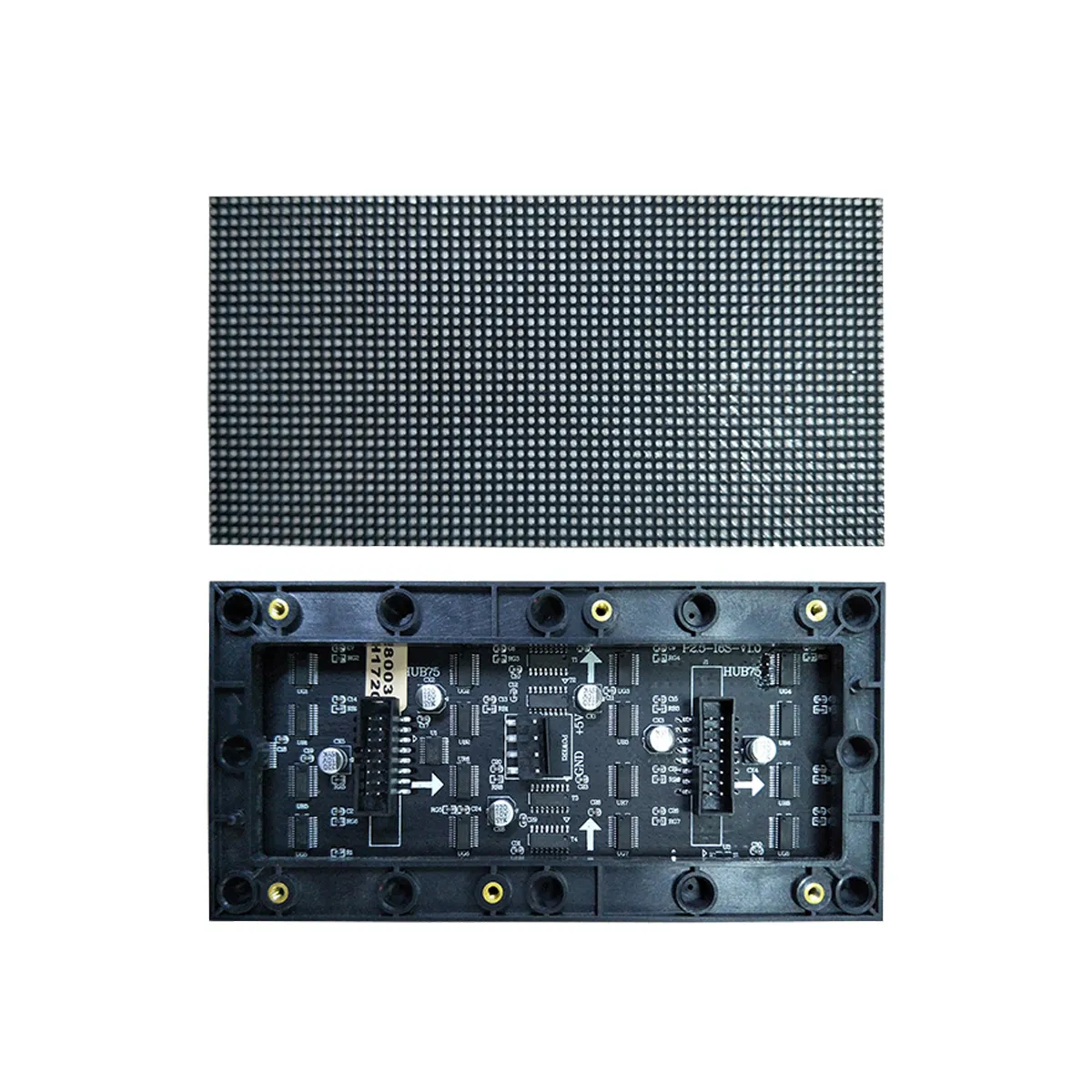
Modular structure: The display wall is composed of multiple standard-sized cabinets. Each cabinet is composed of multiple modules.
Seamless stitching: Professional fine-pitch LED cabinets utilize precision craftsmanship, allowing the physical gap after splicing to be controlled to within 1 mm, or even less than 0.5 mm. Therefore, when multiple video wall are fully connected, you can barely see any black. This creates a truly immersive “wall” visual effect.
How does it differ from regular 4K TVs?
For a clearer understanding, please see the comparison table below:
| Feature | SMD (Surface – Mount Technology) | COB (Chip – on – Board Technology) | Advantage Party |
|---|---|---|---|
| Reliability | Generally, lamp beads are prone to damage from bumps | Extremely high, with fully – sealed protection and impact resistance | COB |
| Surface Flatness | Ordinary, with a grainy feel | Excellent, smooth as a mirror, wider viewing angle | COB |
| Contrast/Black Field | Good | Excellent, with better ink – color consistency | COB |
| Minimum Pixel Pitch | Can achieve below P0.4mm | Currently, the mainstream is above P0.6mm | SMD |
| Cost | Lower, with mature technology and high cost – effectiveness | Higher, with more expensive technology and material costs | SMD |
| Maintenance | Single lamp beads can be replaced | The entire module needs to be replaced | SMD |
4K LED Wall Technology: SMD vs. COB: Which LED packaging technology is right for you?

Currently, the mainstream display packaging technologies used for 4K wall displays are SMD and COB.
SMD Surface Mount Technology:
SMD is a traditional and mature LED packaging technology. It packages LED chips (red, green, and blue) into small beads, which are then mounted on a PCB through a soldering process.
Advantages:
- Mature technology
- Relatively low cost
- High market penetration.
Disadvantages:
- Because the beads are raised, they are easily damaged by external forces.
- High lamp failure rate
- Surface flatness is slightly poor
COB packaging technology:
COB packaging directly bonds LED chips to a PCB in bulk, without encapsulation, and then seals the entire package with epoxy resin.
Advantages:
- More advanced technology.
- The surface of the LED beads is smooth and free of protrusions.
- Extremely protective (anti-collision, dust, and moisture resistance).
- Better heat dissipation.
- Reliability and stability far exceed SMD.
- Better visual quality.
Disadvantages:
- Higher cost.
- Replacing individual LED beads is complex.
For a more intuitive comparison, let’s look at the table below:
| Pixel Pitch (P) | Resolution per Cabinet (Width x Height) | Number of Horizontal Cabinets | Number of Vertical Cabinets | Total Number of Cabinets | Display Area (Width x Height) | Total Pixels |
|---|---|---|---|---|---|---|
| P0.625mm | 960 x 540 | 4 | 4 | 16 | 2.4m x 1.35m | 8,294,400 |
| P0.78mm | 769 x 432 | 5 | 5 | 25 | 3.0m x 1.6875m | 8,294,400 |
| P0.93mm | 645 x 362 | Approx. 6 (5.95) | Approx. 6 (5.97) | 36 | 3.6m x 2.025m | 8,294,400 |
| P1.25mm | 480 x 270 | 8 | 8 | 64 | 4.8m x 2.7m | 8,294,400 |
| P1.56mm | 384 x 216 | 10 | 10 | 100 | 6.0m x 3.375m | 8,294,400 |
| P1.87mm | 320 x 180 | 12 | 12 | 144 | 7.2m x 4.05m | 8,294,400 |
If you have a sufficient budget and are seeking the ultimate display quality and extremely long life, such as for high-end exhibition halls, corporate lobbies, or broadcast studios, we recommend COB walls. Of course, if your budget is limited, you can also choose the high-quality, proven, and reliable SMD 4K display wall.
What area and cabinets are required to create a 4K LED wall?

While 4K resolution is fixed, the physical size of the LED screen depends on the pixel pitch you choose.
Pixel pitch (P) refers to the distance between the centers of two adjacent LEDs. A smaller P value means more pixels per unit area, resulting in a clearer and more detailed display, but also higher costs.
The most popular small-pitch cabinet size on the market today is 600mm × 337.5mm, with optional pixel pitches such as P0.625mm, P0.78mm, P0.93mm, P1.25mm, P1.56mm, and P1.87mm.
Calculation formula:
- Single-panel resolution = Panel size / Pixel pitch
- Number of pixels on the wide side = 600 / P
- Number of pixels on the high side = 337.5 / P
- Required number of panels = 4K resolution / resolution per panel
- Number of horizontal panels = 3840 / (600 / P)
- Number of vertical panels = 2160 / (337.5 / P)
- Total number of panels = Number of horizontal panels × Number of vertical panels
- Total display area = Total number of panels × Area per panel
Next, let’s calculate the specific data for each pixel pitch:
Note:
The number of panels must be an integer, so the result for 0.93mm is rounded up. Therefore, the actual resolution will be slightly higher than the 4K standard, which is normal.
Which pixel pitch is the most cost-effective?

You may be wondering, with so many pixel pitches to choose from. Which pixel pitch is the “most cost-effective”? In reality, it depends on factors such as viewing distance, budget, and space size. Based on our actual test cases, you can refer to the following options:
For optimal visual experience:
You can prioritize P0.625mm and P0.78mm. Screen sizes are approximately 2.4-3 meters wide. This solution is suitable for limited spaces such as high-end conference rooms, brand flagship stores, and luxury home theaters. However, it has the highest cost per square meter.
For cost-effectiveness:
You can prioritize P0.93mm and P1.25mm. Screen sizes are approximately 3.6-4.8 meters wide. They offer excellent clarity even at distances of 2-3 meters and beyond. Furthermore, their cost is significantly lower than products below P0.9. Therefore, this solution is suitable for corporate lobbies, medium-sized exhibition halls, and broadcasting applications.
For cost-effectiveness:
You can prioritize P1.56mm and P1.87mm. Screen sizes are larger, approximately 6-7 meters wide. This solution is suitable for large conference centers, stage backdrops, shopping mall atriums, and offers the lowest total cost.
How much does it cost to build a 4K LED wall?

The cost of a 4K LED wall is far more than just purchasing the screen itself. It’s a comprehensive engineering project. The total cost primarily includes:
1. LED screen hardware cost (approximately 60%-70%)
This is the core cost. Generally, we can quote a price per square meter. This rough market estimate is for reference only. Because brands and craftsmanship vary significantly:
- P1.8+: ¥10,000 – ¥20,000 / square meter
- P1.2 – P1.5: ¥20,000 – ¥40,000 / square meter
- P0.9 – P1.1: ¥40,000 – ¥70,000 / square meter
- P0.6 – P0.8: ¥70,000 – ¥150,000+ / square meter
Using the P1.25mm, our “price-to-performance ratio king,” as an example, let’s assume a price of ¥30,000 per square meter.
- Total display area = 4.8m x 2.7m = 12.96 square meters
- Screen hardware cost ≈ 12.96 × 30,000 = ¥388,800
2. Control system cost (approximately 10%-15%)
This includes transmitter cards, receiver cards (one per cabinet), and a video processor. Optional systems include NovaLCT and Colorlight. Nova is slightly more expensive, by about 20%. A 4K control system costs approximately ¥20,000-¥30,000.
3.Steel structure and installation costs (approximately 10%-20%)
Depending on the site environment, such as whether it is a load-bearing wall or whether it will be ceiling-mounted, custom mounting brackets or keel structures are required, as well as professional installation and commissioning labor. This cost fluctuates significantly, but we estimate it will cost between ¥10,000-¥30,000.
4. Accessories and Supplementary Materials (approximately 5%)
This includes power cables, network cables, distribution boxes, and cooling systems (air conditioning or fans). This costs approximately ¥10,000-¥20,000.
5. Content Source and Software Costs
In addition, you’ll need a high-performance computer, which will cost approximately ¥8,000-¥15,000.
Therefore, taking a 1.25mm pitch as an example, the total cost of a 4K LED wall is estimated to be:
Low-spec option:
¥388,800 (screen) + ¥20,000 (controller) + ¥15,000 (installation) + ¥10,000 (auxiliary components) ≈ ¥433,800
High-spec option (better brand, more complex installation):
¥388,800 (screen) + ¥50,000 (controller) + ¥40,000 (installation) + ¥20,000 (auxiliary components) ≈ ¥498,800
Thus, if you want to build a 1.25mm pitch 4K LED wall, your total budget should be approximately ¥400,000 to ¥500,000. This translates to between $60,000 and $70,000 USD. If you choose a smaller pitch, such as 0.93mm, the total cost could exceed $600,000 to $800,000, which translates to between $100,000 and $120,000 USD.
Conclusion
Building a 4K LED display wall is a significant investment, but the visual impact and brand value it brings are undoubtedly enormous. First, you need find a reputable, professional supplier like Sight LED. We can offer a one-stop solution, including design, installation, commissioning, and after-sales service. This is far more important than simply purchasing a product.
Remember, a successful LED display project is “30% screen, 70% installation.” High-quality products combined with professional installation will become long-term success. If you are interested in a 4K wall, please feel free to contact us.