Ultra-HD display has become an irreversible mainstream trend in the display industry. Among them, 4K/8K resolution is a core necessity for high-end display scenarios. However, in the field of indoor LED displays, despite continuously growing market demand, the large-scale adoption of 4K or even 8K ultra-HD displays has always been constrained by two major bottlenecks: spatial limitations and cost barriers.
The traditional technical approach of simply reducing LED dot pitch has encountered obvious bottlenecks in packaging processes and heat dissipation performance. However, Dynamic pixel technology, with its innovative upgrade in pixel rendering logic, does not rely on extremely small dot pitch products. It has become a key pathway to efficiently realize indoor LED ultra-HD displays.
Core Pain Points of Indoor LED Ultra-HD Displays
To stably achieve high-resolution display effects such as 4K (3840 *2160) and 8K (7680 *4320) on indoor LED screens, the core logic of traditional technical solutions is to “reduce dot pitch and increase physical pixel density”. That arranges more pixel points per unit area by decreasing the spacing between LED beads. This approach directly leads to two intractable industry problems.
Poor spatial adaptability and insufficient scene compatibility
Considering the current mainstream indoor space specifications in China, the typical floor-to-ceiling height of office buildings is about 3.2m; after deducting suspended ceilings, ventilation ducts, and floor finishes, the usable height is only 2.8-3.0m. Meeting rooms and small lecture halls have a floor-to-ceiling height of about 3.9m, with usable height generally between 3.5-3.7m.
To achieve 4K resolution display in such conventional spaces, following the traditional technical solution, It common uses P1.25 LED display with the standard screen size about 4.8m * 2.7m. It occupys almost the entire usable height of the room.
In this case, the screen’s height from the floor is typically less than 0.3m. In scenarios such as meeting presentations or project demonstrations, when participants are seated, the lower part of the screen is often blocked, preventing full display, which severely affects viewing experience and information delivery efficiency.
To achieve an even higher 8K resolution, you need to use ultra-small dot pitch products like P0.7 or P0.6. It results in even larger screen sizes and stricter spatial constraints. Many conventional indoor spaces simply cannot accommodate such installations, limiting them to a few customized, high-ceiling spaces.
Prominent cost and technical bottlenecks hindering large-scale adoption
From a market price perspective, ultra-small dot pitch LED products such as P0.6 are prohibitively expensive, far exceeding the budget limits of most government, enterprise, and commercial scenarios.
Even the relatively cost-effective P0.9 LED display holds a market share of less than 5%, with limited production capacity and an unstable supply chain. Meanwhile, from a technical standpoint, current mainstream COB and SMD packaging technologies have reached their ceiling . once the pitch is reduced below 0.6mm, issues such as heat dissipation from beads, signal interference, and color consistency become acute.
Packaging process difficulty increases significantly, and production costs rise exponentially. Without changing the core technical principles, it is extremely difficult to endlessly reduce dot pitch to meet higher resolution display demands. The traditional technical path is no longer sustainable.
Core Principle of Dynamic Pixel Technology
As a cutting-edge technology in indoor LED ultra-HD displays, dynamic pixel technology primarily draws on the sub-pixel rendering concept from the OLED display field. However, it is not a simple copy; rather, it has been specifically optimized and upgraded for the luminous characteristics of LEDs and large-screen application scenarios.
Its core logic is to achieve a multiple-fold increase in display resolution without changing the physical pixel density of the LED screen or reducing the dot pitch. Through innovative pixel rendering algorithms and optimized driving of light-emitting elements, thereby fundamentally avoiding the pain points of traditional technical routes.
Underlying technical logic: Reconstructing the pixel display mode
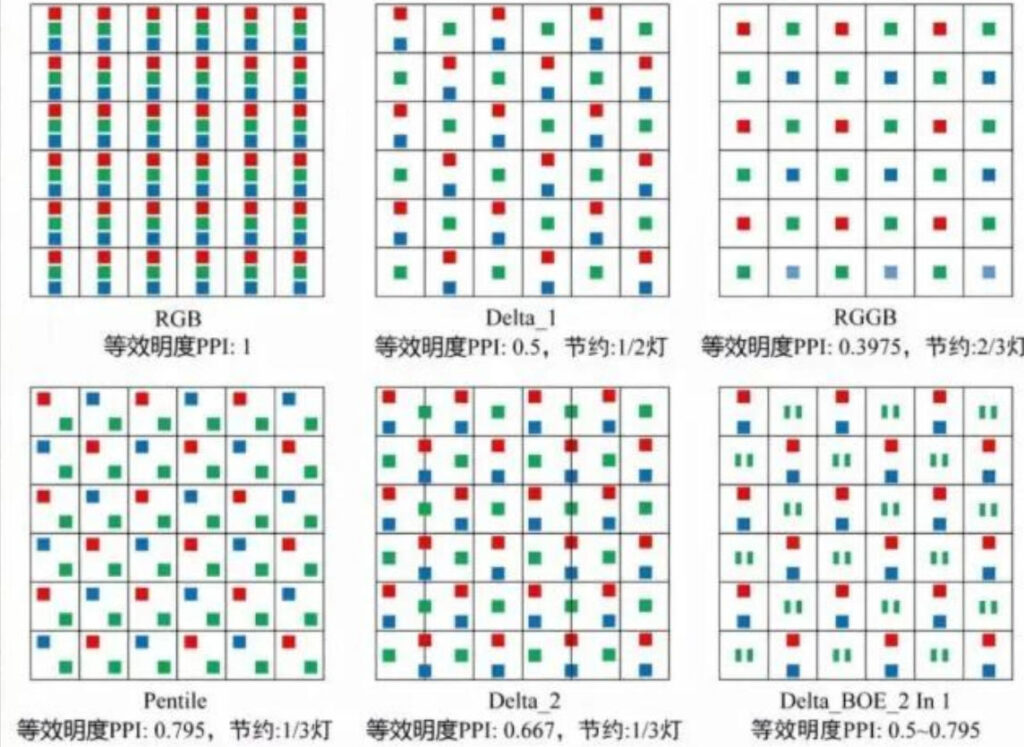
Dynamic pixel technology breaks the traditional LED screen model where “one RGB light set corresponds to one physical pixel.” It splits the conventional integrated RGB pixel into several independently controllable red, green, and blue monochromatic light emitters (LED beads).
These monochromatic emitters are evenly distributed on the screen surface at specific regular intervals. Each monochromatic emitter supports independent driving control and brightness adjustment, allowing flexible switching of operating states according to the display content’s requirements.
During actual display, the system uses dedicated rendering algorithms to control monochromatic emitters in adjacent areas to combine as needed. It simulates the formation of complete RGB pixels. Through precise brightness ratios and color mixing, it reproduces the image’s details, colors, and sense of depth, achieving an effect of “unchanged physical pixels, multiplied virtual resolution.”
Differences from OLED sub-pixel rendering: Tailored for large LED screens
Although dynamic pixel technology borrows the core concept of OLED sub-pixel rendering, there are significant differences in technical details and application suitability, making it better suited to the display requirements of large LED screens.
In OLED’s mainstream diamond pixel arrangement, to balance display quality and power consumption, the number of red and blue pixels is only half that of green pixels. When displaying white or light-colored images, it must borrow light from adjacent pixels to compensate for color deficiencies, thereby ensuring color accuracy.
However, this approach tends to cause uneven color and blurred details on large screens. In contrast, LED dynamic pixel technology optimizes the arrangement density, driving logic, and rendering algorithms of monochromatic emitters. So, it perfectly matches the core characteristics of LED screens:
- High brightness
- High contrast
- Large screen size.
It achieves precise color reproduction without borrowing from adjacent pixels and effectively avoids detail distortion issues on large screens.
Comparison of Core LED Dynamic Pixel Technology Solutions
Currently, several mature implementation solutions for dynamic pixel technology exist within the industry, each with different trade-offs in chip count, resolution improvement, and cost control.
Taking the most widely used P1.25 pitch COB LED screen in indoor LED displays as an example, the performance differences among various dynamic pixel arrangement solutions are significant. The specific parameters and characteristics are compared below:
Core Advantages of Dynamic Pixel Technology Empowering LED Displays
The application of dynamic pixel technology not only fundamentally solves the spatial and cost pain points of traditional indoor LED ultra-HD displays but also leverages technological innovation to upgrade LED display products in three core dimensions: image quality, power consumption control, and operational stability. Therefore, it further expandes the application scenarios of indoor LED ultra-HD displays.
Leapfrog improvement in resolution and greatly optimized spatial adaptability
With dynamic pixel technology, there is no need to switch to ultra-small dot pitch products. Currently mature and economical LED products with pitches such as P1.2 and P1.5 can achieve a 2-3 times increase in clarity, easily overcoming spatial constraints.
According to industry test data, for the same size and same physical pixel count, a 4 * multiplication dynamic pixel display can jump from a conventional resolution of 1920 *1080 (2K) directly to 3840 *2160 (4K) without enlarging the screen size. It can perfectly fit the spatial specifications of conventional office buildings and meeting rooms. So, 4K/8K ultra-HD display projects no longer require high-cost procurement of ultra-small dot pitch products; they can use more mature, cost-effective larger-pitch products, significantly lowering the barrier to implementing ultra-HD displays.
Increased contrast, reduced reflectivity, and clearer image quality
By reducing the number of LED chips per unit area, dynamic pixel technology results in a sparser arrangement of light-emitting chips, effectively improving the overall ink-color uniformity of the screen. Due to non-emitting areas appear purer, it enhances the contrast with emitting areas and creating more vivid image layering.
At the same time, the sparser chip arrangement significantly reduces the reflective surface area on the screen, lowering ambient light reflectivity by more than 30% compared to conventional solutions.
Even in brightly lit meeting rooms or exhibition halls near windows, the display remains clear and transparent, avoiding the impact of reflection and glare on viewing experience. So, it is beneficial for scenarios requiring high image clarity, such as document display and data visualization.
Energy savings, lower temperature, improved stability and lifespan
The reduction in chip count directly lowers the total power consumption of the equipment. Compared to conventional real-pixel solutions, LED screens using dynamic pixel technology can reduce power consumption by 30%-50%, saving significant electricity costs over long-term operation. Meanwhile, heat generation from chips decreases correspondingly, reducing the operating temperature at the screen front by 8-12°C compared to conventional solutions.
This effectively alleviates heat dissipation pressure, reducing problems such as bead attenuation and color shift caused by high temperatures. Not only does this extend the LED screen’s lifespan, but it also lowers subsequent maintenance costs, reducing the frequency of bead replacement and equipment inspection, improving operational stability.
Therefore, dynamic pixel technology are suitable for scenarios requiring 24/7 continuous operation, such as command centers and monitoring halls.
Current Technical Bottlenecks and Breakthrough Directions
Although dynamic pixel technology has achieved large-scale application and become a core driver for the development of indoor LED ultra-HD displays, it is not yet fully mature. Two major issues still need to be addressed in practical applications, and these are the current focus of industry R&D.
High difficulty of back-end rendering algorithms, requiring optimization of color and detail reproduction
The core competitive strength of dynamic pixel technology lies in its rendering algorithms. When the chip count is reduced, a large number of virtual pixel points must borrow adjacent monochromatic emitters to combine and complete the display. Different chip arrangement schemes and different displayed images impose significantly different requirements on the rendering algorithms.
Current mainstream rendering algorithms perform stably for static images and conventional color displays, but for dynamic images and complex colors issues such as color distortion, blurred details, and ghosting can occur. As the multiplication factor of resolution increases, the complexity of the algorithms grows geometrically.
Therefore, rendering technology must evolve simultaneously, optimizing algorithm response speed and color mixing precision to ensure color fidelity and image smoothness across different scenarios, achieving both “high definition” and “high quality.”
Text aliasing issues in 3-LED arrangement schemes, affecting text display experience
According to industry test data, on dynamic pixel displays with mainstream 3-LED 2 * multiplication arrangements, when displaying fine content such as text or tables, the aliasing on horizontal lines of text is very noticeable, especially for small font sizes, where the jagged effect is exacerbated, reducing text clarity and readability.
This is a core shortcoming of the 3-LED arrangement scheme. Solving this problem requires breakthroughs in two directions:
First, optimizing the chip arrangement scheme. It can adjust the spacing and arrangement pattern of monochromatic emitters to reduce pixel loss during text display;
Second, upgrading anti-aliasing rendering algorithms. We can use pixel compensation techniques to fill in the jagged edges of text, improving sharpness and smoothness, and adapting to scenarios such as meeting presentations and document display that demand high text quality.
Summary
Dynamic pixel technology breaks the traditional “dot-pitch-only” mindset for LED ultra-HD displays, overcoming the dual bottlenecks of space and cost. Through innovative pixel rendering, it achieves multiple optimizations in spatial adaptability, cost control, and performance, making it the core technology with the greatest development potential in the current indoor LED ultra-HD display field.
In the future, as the technology matures and becomes widespread, 4K resolution will gradually become standard for LED screens in conventional indoor scenarios such as meeting rooms and exhibition halls, while 8K displays will also be increasingly deployed in high-end scenarios such as command centers, premium lecture halls, and large exhibition venues.