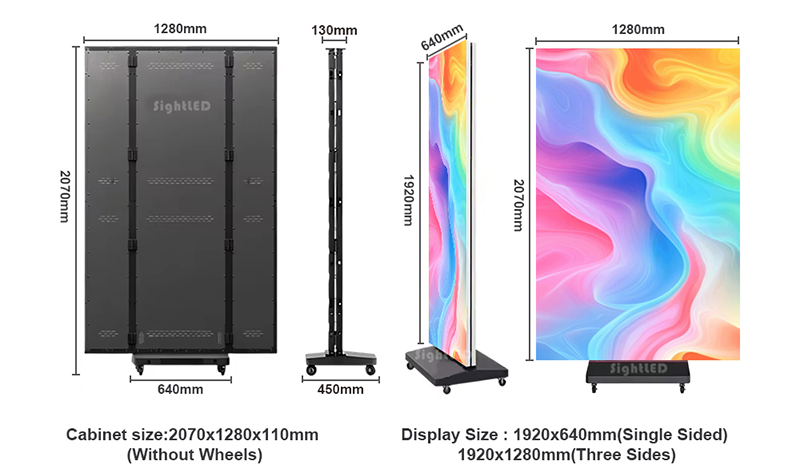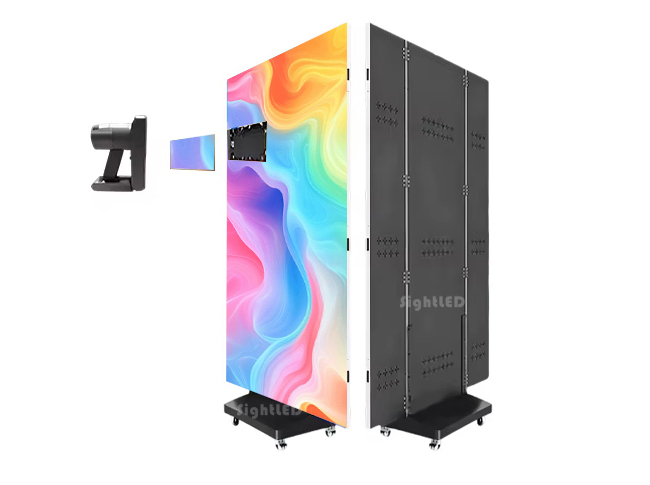
You can have the best product, the most innovative service, or the most compelling message,but if no one looks up from their smartphone or breaks their stride on the convention floor, you’ve lost. Enter the Mobile LED Poster on Wheels, a modern, dynamic solution that is rapidly replacing traditional static signage.
Gone are the days of wrestling with heavy, bulky A-frame sandwich boards or spending hundreds of dollars on vinyl banners that fade after one use. The Mobile LED Poster is a tall, slim, high-brightness digital screen mounted on a sleek rolling base. It combines the portability of a hand truck with the visual punch of a television studio.
Whether you’re orchestrating a high-end corporate conference, launching a limited-time pop-up store, or managing a bustling wedding expo, here’s an in-depth look at why a Mobile LED Poster on wheels is the most versatile tool you can add to your marketing arsenal.
What Exactly is a Mobile LED Poster?
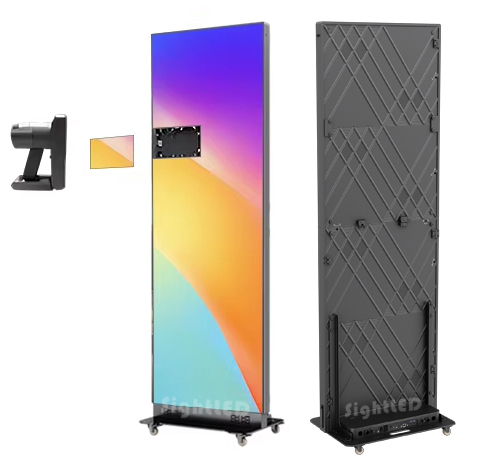
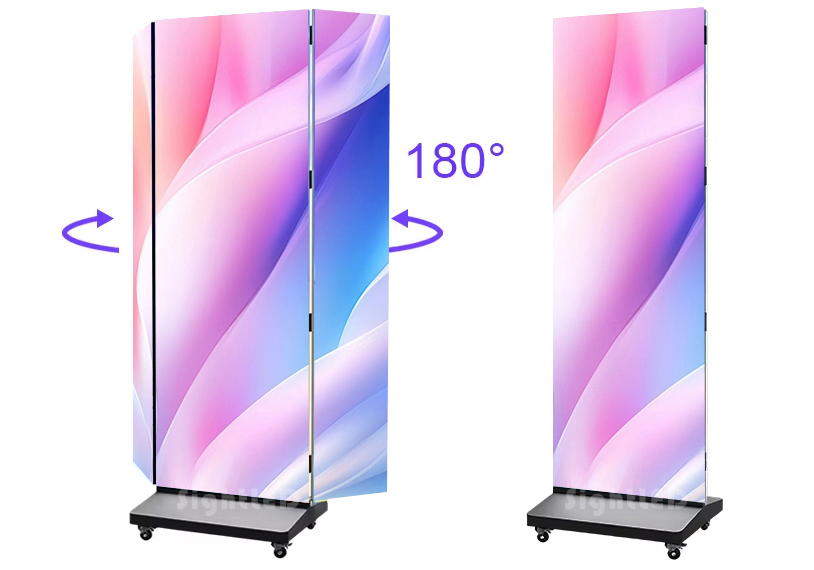
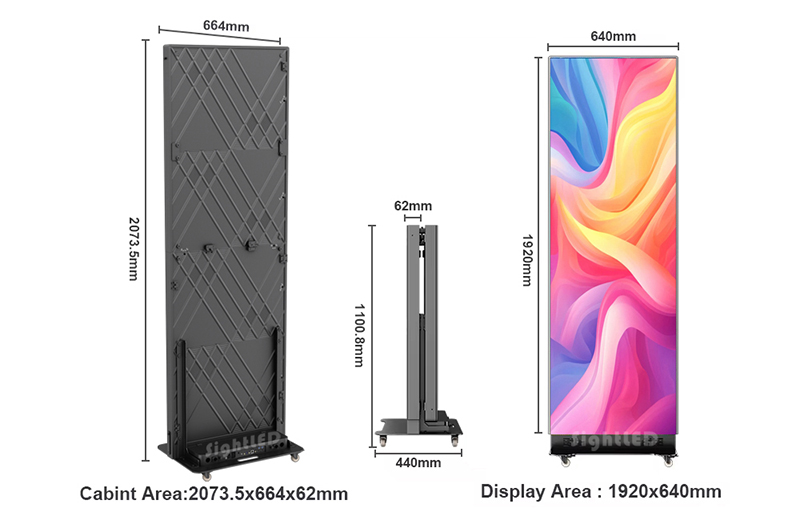
A Mobile LED Poster is a vertical digital signage display . It is encased in a slim aluminum frame and equipped with commercial-grade castor wheels.
Key Technical Specifications:
- Height: Typically ranges from 60 to 75 inches (approx. 1.5m to 1.9m tall).
- Brightness: Usually 500 nits for indoor use, with some models reaching 2,500+ nits for direct sunlight visibility (High Brightness LCD).
- Aspect Ratio: Often 9:16 or 3:4, designed to mimic the look of a human figure or a traditional poster stand.
- Operation: Plug-and-play via USB, SD Card, or Cloud-Based Content Management Systems (CMS).
- Mobility: Lockable, heavy-duty rubber wheels and a built-in battery for untethered operation (usually 4-8 hours per charge).
Unlike a heavy TV on a cart, these units are designed with a consumer-facing aesthetic. The cable management is internal, the frame is stylish, and the entire unit is engineered to be rolled directly onto the sales floor or the trade show booth without looking like a temporary setup.
The Advantages Over Static Signage
Why make the switch from paper to pixels? The return on investment goes far beyond the “cool factor.”
Instant Agility and Zero Printing Waste
Think about the logistics of a traditional event. You order a 24×36 poster print. It arrives with a crease. The promotion ends Sunday, and Monday morning you have a large piece of corrugated plastic headed for a landfill.
A Mobile LED Poster eliminates this cycle entirely. Need to update the menu for the dinner rush? Upload a new JPEG. Need to change the conference room schedule mid-day? Update it from your laptop via Wi-Fi. This real-time adaptability is invaluable in pop-up stores where inventory changes hourly based on foot traffic trends.
Capturing the “Glance Economy”
Human beings are biologically wired to notice movement. Static signs become part of the background noise—what psychologists call “banner blindness.” A Mobile LED Poster uses subtle motion graphics, video clips, and bright, crisp colors to hijack the peripheral vision. Even a simple Ken Burns effect (slow zoom) on a product photo can increase dwell time by 400% compared to a static print. At a loud conference where audio is muffled by crowd noise, the visual motion of an LED poster cuts through the chaos silently and effectively.
Space Efficiency with Monumental Impact
Convention booths and pop-up stores are expensive real estate measured by the square foot. A Mobile LED Poster has a footprint of less than 2 square feet but delivers the visual impact of a 7-foot-tall employee. Because it is vertical, it occupies the air space above the crowd, acting as a beacon that can be seen from across the exhibit hall. When placed at the entrance of a pop-up, it defines the boundary of the space while actively selling to passersby.
Professional Aesthetics
Wheels matter. More importantly, the quality of the chassis matters. Premium mobile posters use aluminum frames with tempered glass fronts, creating a sleek, Apple-like product finish. This is crucial for luxury events, corporate AGMs, or high-end fashion pop-ups where a scuffed-up wooden easel would undermine the brand’s credibility. The wheels are typically hidden behind a magnetic kickplate, ensuring the unit looks like a fixed architectural feature—until you need to move it.
Primary Use Cases: Where the Wheels Hit the Floor
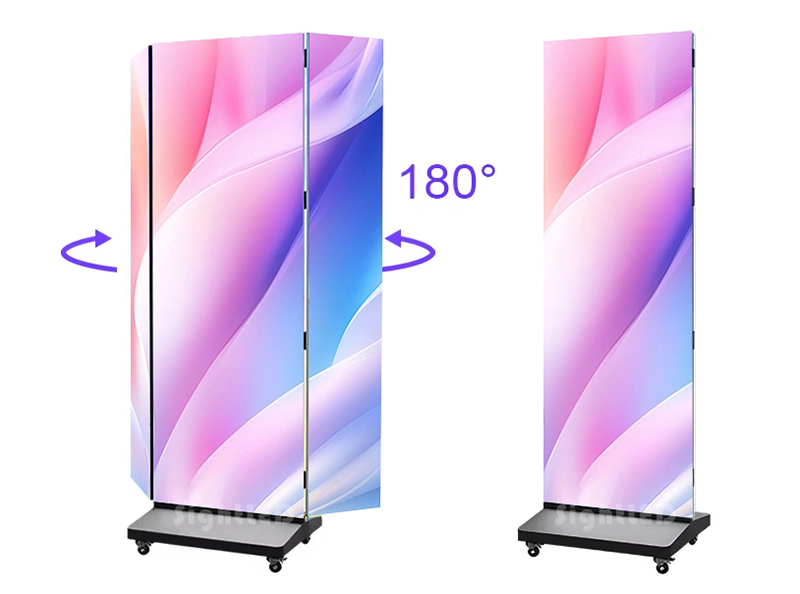
It shines brightest in three specific, high-pressure environments.
Events:
At weddings, galas, and charity fundraisers, you cannot have a salesperson shouting over the string quartet. A Mobile LED Poster placed at the registration desk provides a continuous, elegant loop of:
Welcome Messages: Personalized with the bride and groom’s names.
Seating Charts: Instantly updatable if there’s a last-minute “no-show” or table swap.
Sponsor Recognition: Looping high-res logos of corporate sponsors without cluttering tables with cheap acrylic signs.
Social Media Walls: A live feed of the event hashtag encouraging guests to post and see their faces on the big screen.
Real-World Example: A corporate roadshow uses five Mobile LED Posters at different check-in points. When the keynote speaker is delayed, the event coordinator updates all five screens simultaneously via the cloud to read: “Keynote Begins at 10:45 AM. Please enjoy coffee in the Vista Lounge.” No runner needed to swap out paper signs.
Pop-Up Stores:
Pop-up retail is the ultimate test of logistics. You often have 48 hours to set up a fully functional store that looks like it has been there for years. Mobile LED Posters solve three critical pop-up pain points:
Window Display Replacement: In a mall pop-up with no actual storefront window, rolling a 70-inch vertical screen to the entrance creates a virtual window display showing models wearing the current collection.
Flash Sale Activation: It’s 2:00 PM on a Saturday. Traffic is slow. With two clicks, the screen changes from “New Arrivals” to “FLASH SALE: Next 50 Customers Get 30% Off.” You cannot pivot a printed sign that fast.
Checkout Line Engagement: Place a unit near the register showing “Best Sellers” or “Add-On Items.” It acts as a silent upsell machine, reducing perceived wait time and increasing average order value.
Conferences & Trade Shows:
Trade shows are visual warfare. Your 10×10 booth is competing with the 50×50 booth next door that has a multi-million dollar hanging sign. A Mobile LED Poster levels the playing field.
Vertical Beaconing: Because attendees are usually shoulder-to-shoulder, a floor-standing banner gets blocked by bodies. A 7-foot tall LED screen (especially with a top-mounted logo halo) floats above the crowd, ensuring your booth number and logo are visible from 200 feet away.
Lead Capture & Education: Most units now come with optional touch screen overlays. An attendee can walk up, tap the screen to browse your product catalog, and even scan a QR code to email themselves a spec sheet—all without a sales rep having to spend 10 minutes with a “tire kicker.”
Room Directional Signage: In large convention centers, mobile posters on wheels can be placed at confusing intersections. Because they are battery-powered, they can be positioned exactly in the middle of a hallway where no power outlet exists, guiding footfall toward your sponsored breakout session.
The Financial Case: Mobile LED Poster vs. Traditional Print ROI Calculation
One of the most common questions we receive is: “Is it actually cheaper than just printing a banner?” The answer, over even a moderate timeframe, is a resounding yes. Let’s look at a real-world scenario for a business that attends six trade shows or weekend markets per year.
Scenario: Annual Marketing Cost Comparison
| Expense Category | Traditional Foam Core & Vinyl Banners | Mobile LED Poster (Purchase) |
| Design & Printing Fees | $150 per event x 6 events = $900 | One-time design file upload = $0 |
| Shipping / Freight | $45 per event x 6 = $270 | Wheeled to the spot = $0 |
| Waste Disposal Fee | $30 per event x 6 = $180 | Reusable for 5+ years = $0 |
| Labor (Setup/Teardown) | 30 mins x $25/hr x 6 events = $75 | 5 mins x $25/hr x 6 events = $12.50 |
| Lost Opportunity Cost | Can’t update pricing mid-show | Instant flash sale capability = +15% sales lift |
| Total Annual Cost | $1,425 | $12.50 (plus electricity) |
Break-Even Analysis:
Assuming a high-quality Mobile LED Poster purchase price of $2,800.
Annual Savings on Printing & Logistics: $1,412.50.
Break-Even Point: Less than 2 years.
Asset Value: After 2 years, the hardware is fully paid for by savings alone, and you still own a functional, professional display asset that can be sold second-hand or used for another 3-4 years.
How to Choose the Right Mobile LED Poster
Not all rolling screens are created equal. If you’re considering purchasing rather than renting for long-term use, evaluate these three factors:
Battery Life vs. Weight
For conferences that run 8+ hours, look for hot-swappable battery systems. Some high-end models allow you to change the lithium-ion pack without powering down the screen. Be wary of “all-day battery” claims unless you are running at 50% brightness. For outdoor events, battery life drops significantly in cold weather.
Content Management System (CMS)
The hardware is only as good as the software. You want a CMS that allows:
Scheduling: Set the screen to show “Breakfast Menu” from 7 AM-11 AM and “Lunch Specials” from 11 AM-3 PM automatically.
Remote Rebooting: If the screen freezes at a remote pop-up store, can you fix it from your phone at home?
Multi-Screen Sync: Crucial for events where you want all screens to show the same countdown timer.
High Brightness vs. Indoor Clarity
Indoor (350-500 nits): Perfect for conference halls and mall pop-ups. Colors are rich and viewing angles are wide.
Outdoor/Window (2000+ nits): Essential if the screen will be placed in direct sunlight or inside a storefront window facing the afternoon sun. Note: High-brightness screens are significantly heavier and more expensive.
Wheel Quality
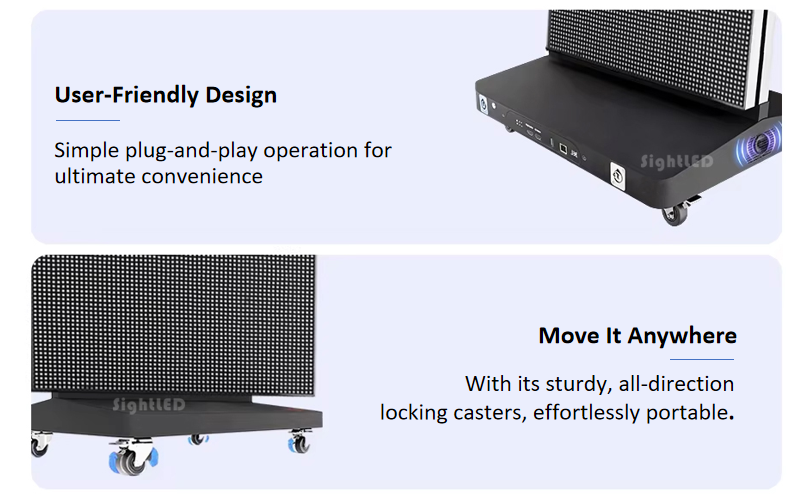
This sounds minor, but it’s the number one complaint from users. Cheap plastic casters will chatter across grout lines in a convention center and potentially tip over. Ensure the unit has locking, rubberized, industrial-grade wheels that can roll smoothly over carpet, tile, and even ADA-compliant door thresholds.
Conclusion:
The Mobile LED Poster on Wheels is more than a gadget; it is a strategic asset. It empowers event managers to be more responsive, retailers to be more agile, and marketers to be more creative.
investing in a solution that literally rolls with the punches is not just smart. it’s essential. Whether you’re unveiling a new product at a trade show or setting up a weekend boutique in a vacant storefront, the ability to stand tall, shine bright, and move freely will set you apart from the static crowd.
So, next time you’re planning an event floor plan, don’t just think about where the tables go. Think about where the light goes. A Mobile LED Poster puts that light exactly where you need it, when you need it, all while sitting silently on a set of perfectly engineered wheels.
FAQs:
What exactly is a Mobile LED Poster?
It is a tall, slim digital display mounted on lockable commercial casters. It looks like an oversized smartphone or a vertical TV and is specifically designed as portable digital signage for retail stores, trade show entrances, and pop-up shops.
How long does the battery last on a Mobile LED Poster?
Standard battery life ranges from 4 to 8 hours depending on brightness settings and video content. For all-day events 10+ hours, we recommend models with hot-swappable batteries so you can change the battery without turning off the screen.
Can I use a Mobile LED Poster outside in direct sunlight?
Yes, but only if you select a High-Brightness (2000+ nits) model. Standard indoor models (350-800 nits) will look washed out and are difficult to see in direct sunlight.
How do I update the content on the screen?
There are three primary methods:
USB/SD Card: Plug and play for simple, local updates.
Cloud CMS / Mobile App: Update remotely via Wi-Fi or 4G for multi-location management.
HDMI Input: Use it as an extended monitor for a laptop during presentations.
What is the difference between a Mobile LED Poster and a regular TV on a cart?
Design intent and durability. Regular TVs are horizontal, have exposed wires, and are not built for 24/7 commercial use. Mobile LED Posters are vertical-native, have internal cable management, commercial-grade panels, and a sleek furniture-grade finish designed to look permanent in a high-end retail environment.
Will the wheels scratch my venue’s floors?
Professional commercial units use rubber-coated, non-marking industrial casters. They are designed to roll silently and smoothly over carpet, tile, and door thresholds without leaving scuff marks. They also feature locking brakes for safety.
Can I play videos or only static images?
You can play full-motion video (MP4), animated GIFs, and high-resolution JPEGs. Using motion graphics increases viewer engagement significantly compared to static posters.
What is the average weight and height? Can one person move it?
The average height is between 67 and 75 inches (1.7m – 1.9m). Weight ranges from 75 to 120 lbs (35kg – 55kg). Because the weight is low in the base and the wheels are high-quality, one adult can easily push and position the unit. Two people are recommended for lifting over stairs or curbs.
What are the typical dimensions and resolution?
Most units feature a 1080×1920 (Full HD) resolution in a 9:16 aspect ratio. From a normal viewing distance of 3-4 feet, the image is sharp and free of pixelation. For displaying fine print or spreadsheets, look for 4K resolution models.
Is it better to rent or buy a Mobile LED Poster?
Rent: Ideal for a one-off event or a 3-day trade show.
Buy: More cost-effective if you host more than 4 events per year or operate a permanent pop-up location. The break-even point against print costs is typically within 18-24 months.
How do I sync multiple screens to show the same countdown timer?
This requires a model with Cloud-Based CMS software. You create a “Group” in the software, and all screens assigned to that group will play the same content simultaneously with a sync delay of less than half a second.
Why does my screen keep turning off by itself?
This is almost always due to the built-in scheduler/timer being enabled. Check the on-screen display (OSD) menu settings for “Auto Power Off” or “Sleep Timer.” Also, check the battery threshold setting if running untethered.
What happens if the screen gets damaged? Is it repairable?
Commercial units feature a protective tempered glass overlay. If the internal LCD panel is damaged, it can be replaced by a commercial AV technician. Crucial Tip: Ensure your warranty is a “Commercial Use Warranty.” Consumer TV warranties are often voided if used at a trade show or business event.
Do I need a Wi-Fi connection to use it?
No. You can operate the screen completely offline using content loaded onto a USB drive or SD card. Wi-Fi is only required for remote content management or live social media feeds.
What is the difference between a Digital A-Board, a Rolling Kiosk, and a Mobile LED Poster?
These terms are often used interchangeably, but there are nuances:
Mobile LED Poster: Tall, vertical, sleek design focused on replacing static posters.
Digital A-Board: Usually shorter, double-sided, and shaped like a traditional sidewalk sign.
Rolling Kiosk: Often includes a touchscreen for interactive wayfinding or product catalogs.