Outdoor LED screens are increasingly prominent fixtures on building facades. However, behind every glowing display is a structural calculation. It determines whether the installation stands safely for decades or becomes a liability waiting to happen.
The structural safety of an outdoor LED screen is directly determined by two factors:
- The accuracy of load calculations
- The soundness of the structural design.
Wind load is the dominant control load in most installations, and projects in coastal typhoon zones or at significant heights demand heightened attention to wind resistance, overturning resistance, and seismic design.
Today, SightLED will guide you calculation detail. This guide is compiled in accordance with the Chinese national standards GB 50009-2012 and GB 50017-2017. It applies to wall-mounted, rooftop ground-based, and post-mounted outdoor LED screen installations.
Design Basis and Load Combinations

Core Standards
Three national standards govern the structural design of outdoor LED screens in China:
- GB 50009-2012: Code for Load Design of Building Structures
- GB 50017-2017: Standard for Design of Steel Structures
- GB/T 50011-2010 (2024 edition): Code for Seismic Design of Buildings
Load Types That Must Be Calculated
A complete structural analysis must account for four categories of loads:
Permanent loads include the self-weight of the LED screen panels, the steel frame structure, and all auxiliary materials. These act consistently downward and form the baseline of every structural calculation.
Variable loads are dominated by wind load, which is the primary controlling load. Wind load governs overturning, deformation, and collapse risk,especially in elevated or coastal installations.
Accidental loads encompass seismic actions. These must be calculated when installation height exceeds 10 meters or when the site falls within a seismic fortification zone.
Additional loads cover factors specific to harsh environments: salt spray corrosion in coastal areas, thermal stress from temperature fluctuations, and maintenance live loads, typically taken as 0.5 kN/m².
Load Combination Formulas
Three load combination scenarios apply to different design states:
For the serviceability limit state (normal use conditions):
1.0 × Permanent Load + 1.0 × Wind Load
For the ultimate limit state (structural capacity under maximum stress), the governing combination is:
1.2 × Permanent Load + 1.4 × Wind Load
For the seismic combination:
1.2 × Permanent Load + 1.3 × Seismic Action + 0.6 × Wind Load
Wind Load Calculation Methodology
Wind load is the heart of any outdoor LED screen structural analysis. The standard calculation formula is:
wk = βz × μs × μz × w₀
Where:
- wk = characteristic wind load value (kN/m²)
- w₀ = basic wind pressure (kN/m², 50-year return period)
- μz = wind pressure height variation coefficient
- μs = wind load shape coefficient
- βz = gust factor
Selecting Key Parameters
Basic Wind Pressure (w₀)
The basic wind pressure is region-specific and corresponds to the 50-year return period value from meteorological records:
- Inland cities: 0.35–0.40 kN/m²
- Coastal and typhoon-prone areas: 0.50–0.65 kN/m²
- Conservative design baseline: ≥ 0.45 kN/m²
- For ultra-high or waterfront installations: use actual measured values from the local meteorological authority
Wind Pressure Height Variation Coefficient (μz)
Wind speed increases with height above ground. The following values apply:
| Installation Height | μz Value |
| ≤ 10 m | 1.00 |
| 10–20 m | 1.25 |
| 20–30 m | 1.42 |
| 30–50 m | 1.62 |
| > 50 m | Interpolated per GB 50009 |
Wind Load Shape Coefficient (μs)
The shape coefficient captures how wind interacts with the screen’s geometry. All four faces must be considered, and the most unfavorable value governs:
- Front face (windward, primary direction): μs = +0.8
- Rear face (suction/negative pressure): μs = -0.6
- Side faces: μs = -0.7
- Design principle: use the maximum front-face wind pressure as the controlling value
Gust Factor (βz)
The gust factor accounts for the dynamic, turbulent nature of wind as opposed to mean wind speed:
- Wall-mounted LED screens: 1.7–1.8
- Rooftop cantilevered or high-altitude smooth screens: 1.9–2.0
- Open-mesh or perforated screens: 1.6–1.7
Complete Engineering Calculation Example
To illustrate the full calculation process, consider a real-world scenario:
Project conditions:
- Installation height: 15 m
- Location: inland city, wall-mounted installation
- Screen area: 20 m²
- Parameters: w₀ = 0.40, μz = 1.25, μs = 0.8, βz = 1.8
- Safety factor: 1.5
Step 1 — Characteristic Wind Load Value:
wk = 1.8 × 0.8 × 1.25 × 0.40 = 0.72 kN/m²
Step 2 — Design Wind Load:
wk(design) = 0.72 × 1.5 = 1.08 kN/m²
Step 3 — Total Wind Force on Screen:
F = 1.08 × 20 = 21.6 kN
Step 4 — Overturning Moment (wall-mounted):
M = F_total × d
Where d is the horizontal distance from the screen’s center of gravity to the wall face. This moment determines the required strength of the anchor bolts and frame connections.
The total wind force of 21.6 kN acting on this relatively modest 20 m² screen illustrates why structural engineering cannot be an afterthought. Larger screens, greater heights, or coastal locations would produce significantly higher design loads.
Installation Type-Specific Design Requirements
Different installation configurations present distinct structural challenges and require tailored approaches.
Wall-Mounted LED Screens
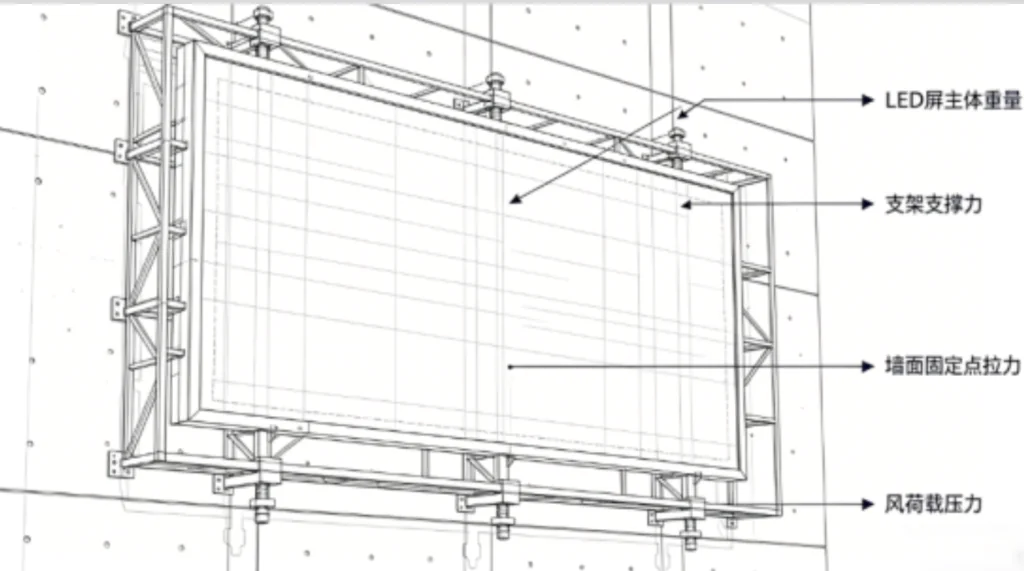
Load controls:
Wind load combined with self-weight. Critical checks include anchor bolt pullout strength and shear force capacity.
Frame construction:
Vertical primary members combined with horizontal secondary members, spaced at maximum 500 mm intervals.
Anchoring requirements:
Chemical anchors or expansion bolts must be used. Anchoring into hollow brick or aerated concrete blocks is strictly prohibited. These materials cannot reliably develop the required pullout capacity.
Height limitation:
Wall-mounted configurations are appropriate for installations up to 30 m. Beyond this height, a dedicated reinforcement design is required.
Rooftop Ground-Based LED Screens
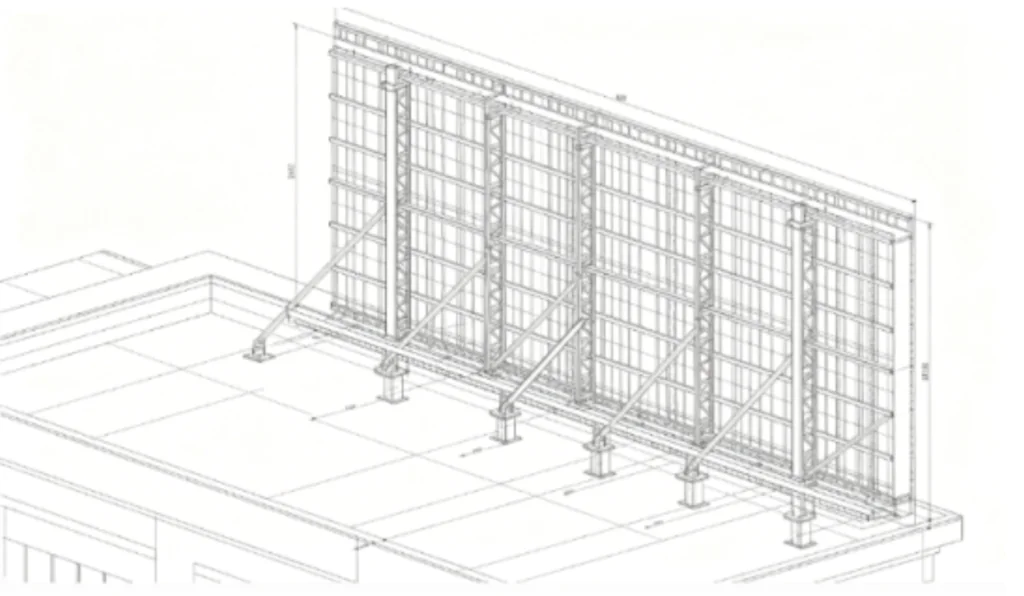
Required calculations:
Wind load, overturning moment, self-weight, and seismic action must all be evaluated.
Anti-overturning measures:
Increase base counterweight mass, embed anchor bolts into the structural slab, and add triangular trusses or diagonal bracing.
Mandatory requirement:
Any installation exceeding 6 m in height must incorporate seismic-resistant detailing, and the counterweight anti-overturning safety factor must be no less than 1.2.
Post-Mounted LED Screens (Single and Double Column)
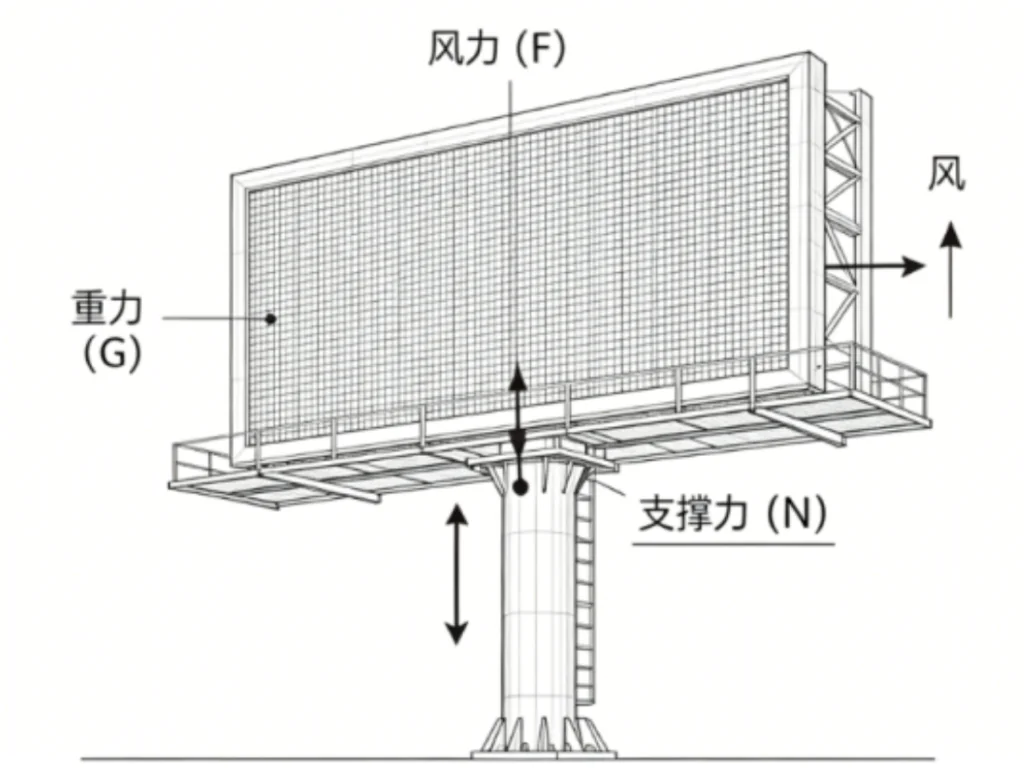
Primary risks:
Single-sided wind loading creates torsional moments and wind-induced oscillation (wind sway).
Design requirements:
Column tube diameter and wall thickness should be upgraded one grade above minimum, and the foundation cap should be enlarged accordingly.
Structural measures:
Install tie rods or cross-bracing at the top, add lateral bracing between columns, and minimize dynamic sway.
Foundation requirements:
Independent foundation embedment depth must be at least 1.2 m, and the foundation must satisfy pullout, shear, and overturning resistance criteria simultaneously.
Structural Safety and Corrosion Protection
Steel Structure Corrosion Protection
The standard process for corrosion protection in outdoor LED screen structures follows a two-layer system: hot-dip galvanizing as the base layer, followed by an anti-corrosion topcoat.
All weld joints must receive timely touch-up with anti-rust paint after welding. In coastal and marine environments, fluorocarbon topcoat should be applied as an additional protective layer. For structures in typhoon-prone coastal zones, the corrosion protection grade should be elevated, and all metal components should receive comprehensive salt spray protection.
Deflection and Deformation Control
The serviceability limit for deflection is L/250, where L is the support span. Unacceptable conditions include panel buckling or warping, visible oscillation during normal wind, and permanent deformation of the frame structure.
Typhoon Zone Special Reinforcements
For installations in regions subject to typhoon-level winds, all load parameters must be increased by a factor of 1.1. Steel tube and section wall thicknesses should be increased by 0.5 mm beyond standard requirements. Additional rear-face bracing and diagonal supports must be incorporated to enhance overall structural rigidity.
Wind Pressure Relief Design
A common and dangerous mistake is fully sealing the rear panel of an LED screen. Sealed backs create high negative pressure suction on the screen body when wind strikes. The correct approach is to leave ventilation and pressure-relief gaps in the rear cover, which reduces negative pressure suction and lowers the total structural load on the screen.
Acceptance Criteria and Safety Assessment
Before an outdoor LED screen installation is accepted as structurally safe, it must satisfy all of the following:
- The load calculation report is complete, with all parameters selected in accordance with applicable standards
- Steel structure material grade, wall thickness, and corrosion protection all meet design specifications
- Anchor point pullout tests pass with no loosening or slippage observed
- Under wind loading during testing, no significant deformation, oscillation, or abnormal noise occurs
- Coastal and high-altitude projects have completed dedicated wind resistance structural verification
Summary
Outdoor LED screen load calculation centers on wind load as the primary control variable. We need to choose right parameter. You should require careful consideration of installation height, geographic location, and installation type . None of these factors can be addressed generically.
A few critical principles to carry forward:
Wind load is not optional. Every outdoor LED screen, regardless of size or apparent simplicity, requires a formal wind load calculation before fabrication and installation.
Height multiplies risk. A screen at 30 m experiences dramatically higher wind forces than an identical screen at 10 m, due to both the height variation coefficient and the gust factor for cantilevered installations.
Coastal environments demand more. Salt spray, higher basic wind pressures, and typhoon risk all call for a comprehensive upgrade of structural and protective specifications.As a professional manufacturer of LED displays, we possess extensive experience in outdoor LED screen projects. If you are planning to purchase and install an outdoor LED screen, please feel free to contact us.