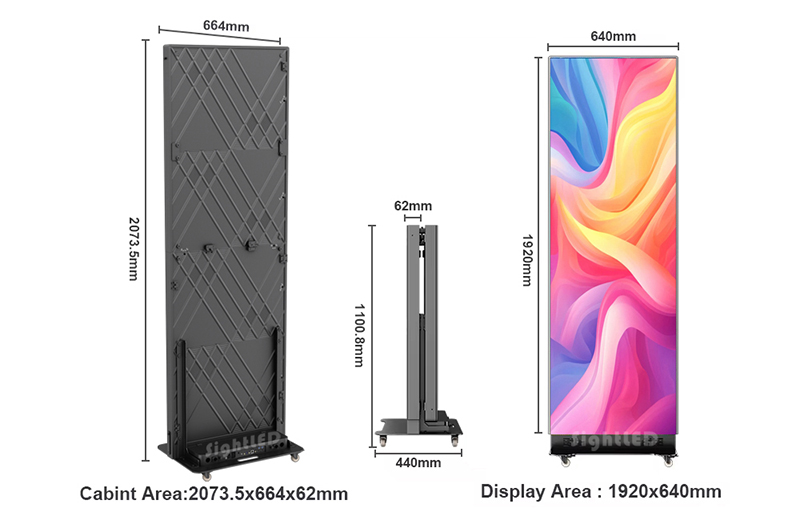
30-Second Verdict if you’re in a hurry:
- Bright store ,like skylights, windows, track lighting: LED Poster wins. It stays vivid, has true blacks, no glare.
- Dim store ,like mood lighting, cinema lobby: LCD Poster saves money and looks sharp.
- Viewing from < 3 feet: LCD.
- Viewing from > 3 feet: LED.
Walking into a modern retail store, you are bombarded with visual noise.LED Posters shout discounts, screens flicker with new arrivals, and digital displays fight for a fraction of a second of your attention. But here is the brutal truth for store owners: ambient light is the enemy of digital signage.
If you have ever installed a beautiful screen only to watch it wash out into a dull, grey rectangle under your track lighting or next to a sunny window, you know the struggle. The question of whether to invest in an LED Poster or an LCD Poster is not just about pixels or price.
In a bright store, “pop” equals sales. If the display doesn’t snap, crackle, and demand attention, it is just an expensive mirror.
Let’s settle the score. Which technology actually holds its own against the harsh glare of retail lighting? We put them head-to-head.
The Contenders:
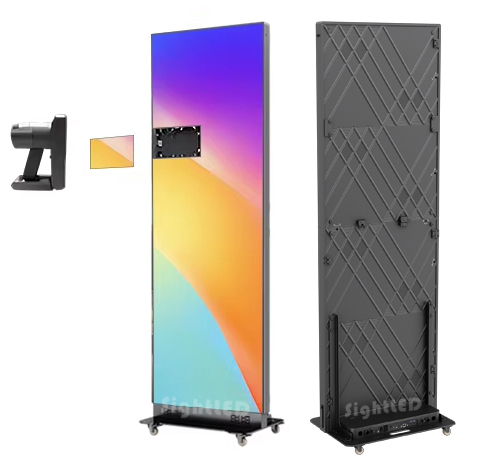
Before we throw punches, let’s clarify what we are actually comparing.
LCD Posters: These are essentially giant versions of your living room TV. They use a backlight shining through liquid crystals and color filters. They are ubiquitous, cheap to produce, and offer excellent color accuracy in dark rooms.
LED Posters: Do not confuse these with “LED-backlit LCDs.” True LED posters use individual Red, Green, and Blue LEDs as the actual pixels. They are modular. It is often seamless, and built like brick houses. These are the displays you see in Times Square or on stadium scoreboards, now slimmed down for indoor retail.
| Feature | LCD Poster (Standard) | LED Poster (Fine Pitch Indoor) |
|---|---|---|
| Brightness (nits) | 250–450 (up to 1,500 with expensive high‑brightness model) | 1,000–3,000+ |
| True blacks | No (backlight bleed) | Yes (pixels turn off) |
| Glare / reflection | Glossy surface, mirror‑like | Anti‑glare, black‑faced, absorbs light |
| Viewing angle | Color shift & 50% brightness loss at 30° off‑center | Consistent color up to ~170° |
| Seamless tiling | No (bezel lines) | Yes (modular, zero bezels) |
| Max operating temp | ~40°C (104°F) | ~60°C (140°F) |
| Lifespan | 30,000–50,000 hours | 100,000+ hours |
| Upfront cost (55” equiv.) | $800 – $2,500 | $3,000 – $5,000 |
| Best for | Dim rooms, close viewing (<3 ft) | Bright stores, >3 ft viewing distance |
The Brightness Battle (Nits vs. Reality)
This is the knockout round. Brightness is measured in nits. The higher the nits, the harder the punch.
Standard LCD Poster: 250 to 450 nits.
High-Brightness LCD Poster: 700 to 1,500 nits
LED Poster: 1,000 to 3,000+ nits .
The Analysis:
A standard LCD at 350 nits is designed for a dim living room. Put that in a brightly lit grocery store with 1,000 lux of ambient light, and the contrast ratio collapses. Blacks become grey; whites become blindingly grey. The image looks “milky.”
An LED poster operating at 1,500 nits behaves differently. Because the LEDs are so bright, they physically overpower the ambient light hitting the screen. You don’t lose contrast because the “off” pixels are truly black , while the “on” pixels are blazingly bright.
Winner: LED Poster. In a bright store, an LED poster doesn’t just survive; it dominates. It looks the same at 2:00 PM under skylights as it does at 8:00 PM.
The Glare Factor (Matte vs. Glossy)
Brightness is useless if the glass turns your beautiful ad into a reflection of the customer standing in front of it.
LCD Posters almost universally use a glossy or semi-glossy protective glass. Why? Because it makes colors look deep and rich in dark showrooms. However, in a bright store, that glossy surface becomes a mirror. You have likely seen this: a digital menu board where you can see the pizza chef walking behind you better than you can see the pizza price.
LED Posters typically use high-transparency, anti-glare, or even black-faced LED modules. Because the LEDs are recessed in a black casing, the surface is naturally non-reflective. It absorbs ambient light rather than bouncing it back at the viewer.
Winner: LED Poster. It maintains “viewability” from almost any angle under any light condition.
Viewing Angles
In a retail store, customers are moving. They are not sitting dead-center in a chair like they are watching Netflix. They are walking past at a 45-degree angle, looking up from a low shelf, or glancing over their shoulder.
LCD Technology has a physical limitation. As you move off-axis, the contrast inverts. Whites turn yellow, blacks turn purple, and brightness drops by 50% at just 30 degrees off center. This is physics; you cannot fix it without expensive IPS panels, which still struggle in high ambient light.
LED Technology is Lambertian. This fancy term means the light scatters evenly. An LED poster loses some brightness at extreme angles . It is close to 170 degrees, but the color accuracy remains. There is no color inversion. The message stays true whether you are walking directly toward it or passing by it to get to the checkout.
Winner: LED Poster. For high-traffic, fast-moving environments, you need a display that works for the whole store, not just the one person standing in the “sweet spot.”
The “Seamless” Factor (Borders vs. Infinity)
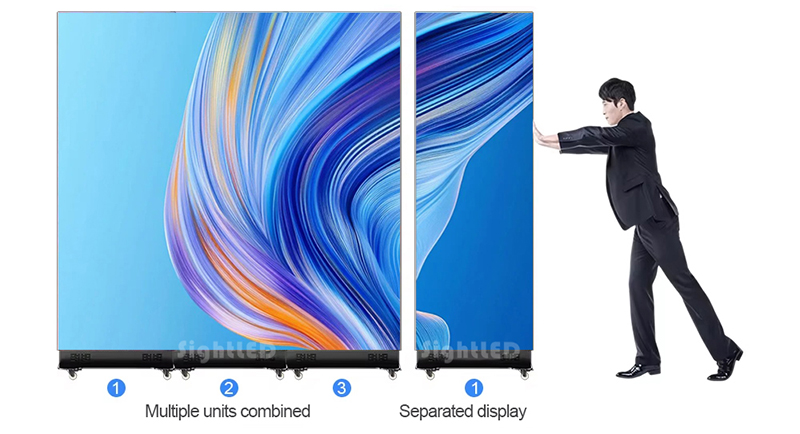
While this doesn’t strictly affect “pop” in terms of brightness, it affects visual dominance.
LCD Posters come with a bezel. It has a black plastic frame around the image. If you try to tile multiple LCDs to make a large poster, you get a distracting grid of black lines.
LED Posters are modular. You can make them any shape or size with zero bezels. In a bright store, a seamless LED wall looks like a portal to another world. It feels futuristic. It feels expensive.
The Psychological Pop: A seamless, frameless image creates a “wow” factor that a boxed-in LCD cannot match. It tricks the brain into thinking the wall itself is changing color.
Winner: LED Poster.
The “Shelf Life” in Hot Environments
Bright stores are often hot stores. If you have high ceilings or kitchen equipment nearby, the ambient temperature rises.
LCD Posters hate heat. They have a maximum operating temperature of about 40°C (104°F). If the store gets hotter, the liquid crystals slow down, you get ghosting, and the backlight dims to protect itself. Eventually, the capacitors blow, and the screen dies.
LED Posters run hot by nature , but they are designed for it. Operating temperatures up to 60°C (140°F) are standard. Because they are passively cooled, they last 100,000 hours. It is roughly 11 years of 24/7 operation.
Winner: LED Poster. Lower total cost of ownership in harsh environments.
The One Area Where LCD Wins
We have to be fair. If LED is so great, why do stores still buy LCDs?
Pixel Density and Viewing Distance.
If your customer is standing 6 inches away from the screen ,like an ATM or a wayfinding kiosk, an LCD looks sharper. A 4K LCD has a pixel pitch of about 0.3mm. An LED poster typically has a pixel pitch of 1.5mm to 2.5mm for indoor retail.
If you put your nose against a 2.5mm LED poster, you see individual dots. On an LCD, you see smooth color.
The Verdict: If the poster is meant to be read from arm’s length (30cm / 1 foot), buy an LCD. If the poster is viewed from 3 feet away or more, the LED is indistinguishable from print quality.
Upfront vs. Long‑term cost (55” equivalent):
| Items | Standard LCD | High‑Brightness LCD | Fine‑Pitch LED (P1.5) |
|---|---|---|---|
| Unit price | $800 | $2,500 + $500 anti‑glare filter | $3,500 |
| Lifespan (hours) | 40,000 | 40,000 | 100,000 |
| Cooling needed | Passive (but needs airflow) | Active (loud fans) | Passive |
| Energy cost (5 years) | $300 | $600 | $400 |
| Replacement risk in bright store | High (washes out, fails early) | Medium | Very low |
Which one actually “Pops”?
Let’s go back to the question: Which one pops more in bright stores?
The answer is unequivocally LED Poster.
LCD pops in a dark room. In a bright store, it whispers.
LED pops in a hurricane of light. It screams.
Why LED is the King of Bright Retail:
Brute Force: 1,500+ nits overpowers sunlight.
True Blacks: Off pixels = zero light, maintaining infinite contrast even under glare.
No Reflection: Matte/black-faced surfaces absorb ambient light.
Heat Tolerance: It won’t shut down when the AC breaks.
Seamless Size: You aren’t limited to a 55″ box.
The Caveat: The Price of Pop
LED posters cost more upfront. A 55-inch LCD might cost $800. A P1.5 55-inch roughly 1200x675mm LED posterwill cost $3,000 to $5,000.
However, in a bright store, the $800 LCD is a paperweight. You will need to buy a High Brightness LCD ($2,500) plus a $500 “high ambient light” filter just to get 70% of the LED’s performance.
When you factor in lifespan and the energy cost , the math changes.
Final Recommendation for Store Owners
Buy the LCD if:
- The store is dimly lit ,like restaurant with mood lighting, cinema lobby.
- The screen is behind glass or in a shaded alcove.
- Customers are touching the screen and viewing from 12 inches away.
- Your budget is under $1,000 and brightness isn’t a priority.
Buy the LED if:
- You have skylights, windows, or track lighting.
- You want to replace static vinyl posters with motion video.
- You need a seamless wall larger than 65 inches.
- The store has high ceilings
- You want customers to stop walking and stare.
Summary:
In a brightly lit store, an LCD poster fights the light and loses contrast, while an LED poster harnesses the light and uses brute brightness to make your colors explode.
If you want your promotions to “pop” or if you want the customer pushing a cart 50 feet away to turn their head and look , do not buy a TV. Buy an LED poster. It is the difference between a whisper and a shout in the noisy arena of retail.
FAQs:
Which is brighter for a sunny storefront, LED or LCD poster?
LED posters typically reach 1,500–3,000 nits, while standard LCDs offer only 250–450 nits. For sunlit or brightly lit stores, LED wins by a large margin.
Do LCD posters look bad in bright retail lighting?
Yes. Ambient light washes out LCD contrast, making blacks look gray and colors appear faded. They are designed for dimmer environments like living rooms or dark restaurants.
Can I use a consumer TV as a digital poster in my store?
Not recommended. Consumer TVs have even 200–300 nits lower brightness, poor heat tolerance, and are not built for 16/7 or 24/7 operation.
What is the lifespan of an LED poster vs an LCD poster?
LED posters typically last 100,000+ hours . LCD posters often fail or degrade significantly after 30,000–50,000 hours.
Which is more energy–efficient at high brightness?
LED posters. To achieve 1,500+ nits, an LCD requires much more power and active cooling (fans), while LEDs are passively cooled and more efficient.
Do LED posters have glare problems like glossy LCD screens?
No. Most LED posters use black-faced, anti-glare modules that absorb ambient light rather than reflecting it.
What pixel pitch do I need for an indoor LED poster?
For viewing distances of 3–6 feet, you can use P1.5 to P2 P2.5. For closer viewing under 3 feet, LCD or a P1.2 or lower finer-pitch LED is better.
Can LED posters show true black?
Yes. Each pixel turns off completely, creating true black and infinite contrast ratio.
Are LCD posters cheaper to buy?
Yes, upfront. A 55” LCD may cost $800, but a high-brightness LCD with anti-glare treatment can reach $3,000. A fine-pitch LED poster starts around $3,000–5,000 but lasts longer.
Which is better for a grocery store with bright ceiling lights?
LED poster. High ambient light kills LCD contrast. LED maintains vivid color and readability even directly under track lighting.
Do LED posters require special mounting or ventilation?
Most indoor LED posters are passively cooled and can be mounted flush to a wall. LCDs require airflow clearance to prevent overheating.
Can I use an LCD poster if my store has dim lighting?
Yes. In dark environments , LCD offers excellent color accuracy and sharpness at a lower cost.
Which technology handles wide viewing angles better?
LED. LCDs suffer from color shift and brightness drop at just 30° off-center. LEDs maintain color accuracy up to nearly 170°.
Can I tile multiple LCDs into a large seamless display?
No. LCDs have bezels that create visible black lines. LED posters are modular and can be made completely seamless.
What is the most important spec for a bright store digital signage?
Sustained brightness (nits) and contrast under ambient light. For most bright retail environments, minimum 1,000 nits with true black is required,which means LED.